
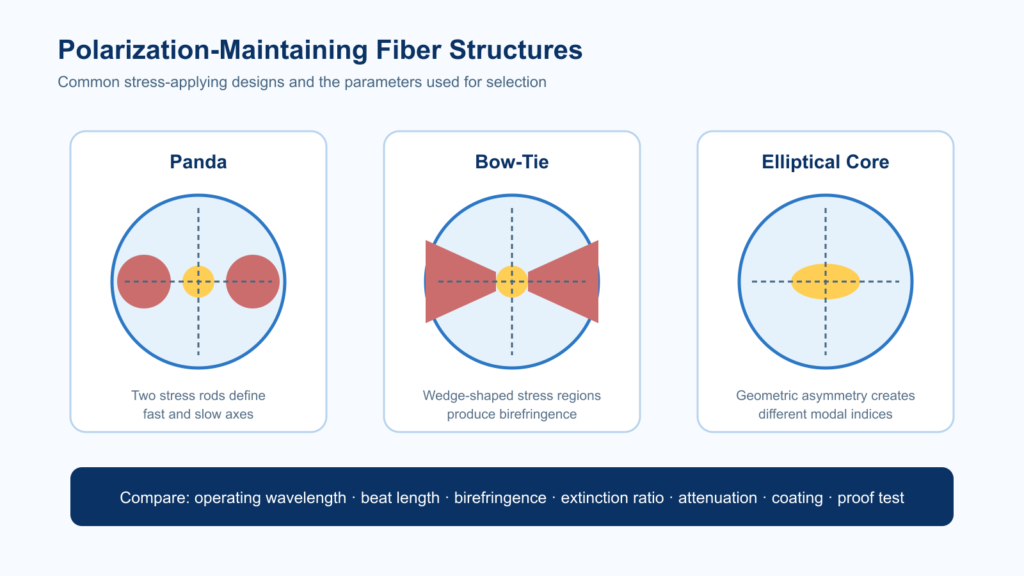
Polarization maintaining fiber (PM fiber or PMF) is a specialty optical fiber engineered to preserve the orientation of linearly polarized light. It is used when polarization stability directly affects measurement accuracy, signal quality, interferometric visibility, or laser performance. For buyers, the correct PM fiber is not selected by wavelength alone: fiber geometry, beat length, polarization extinction ratio, attenuation, mode-field diameter, coating, proof-test level, and termination all matter.
Quick answer: PM fiber creates two clearly separated orthogonal polarization axes through intentional birefringence. When linearly polarized light is launched along one principal axis, coupling into the other axis is minimized, allowing the polarization state to remain stable over the fiber length.
Key takeaways for B2B buyers
- Match the operating wavelength and single-mode range before comparing other specifications.
- Confirm the required polarization extinction ratio (PER) at the actual assembly length and connector type.
- Specify whether you need bare fiber, coated fiber, cable, pigtails, patch cords, or a custom assembly.
- Ask for test data that corresponds to the delivered configuration, not only nominal fiber values.
What is polarization maintaining fiber?
Polarization maintaining fiber is a form of birefringent optical fiber. In conventional single-mode fiber, small stresses, bends, temperature changes, and installation forces can cause energy to couple between two orthogonal polarization modes. PM fiber reduces that coupling by introducing a deliberate difference in refractive index between two principal axes, commonly called the fast axis and slow axis.
The design does not “create” polarized light. Instead, it helps preserve a linear polarization state that has been accurately aligned to one of the fiber’s principal axes. Launch alignment, handling, splicing, and connector key orientation are therefore as important as the glass design.
How does PM fiber work?
PM fiber uses high birefringence to separate the propagation constants of the two orthogonal polarization modes. Because the modes accumulate phase at different rates, random perturbations are less likely to transfer significant power from one axis to the other. This produces a short beat length and improved polarization stability.
Three terms appear frequently in specifications:
- Beat length: the distance over which the phase difference between the two polarization modes changes by one full cycle. A shorter beat length generally indicates stronger birefringence.
- Polarization extinction ratio (PER): the ratio between optical power in the desired and undesired polarization axes, usually expressed in dB. The final PER depends on launch alignment, fiber length, bends, splices, connectors, stress, and measurement conditions.
- Cross-talk: a measure of unwanted coupling between polarization axes. Test length and environmental conditions must be stated when comparing values.
Common types of polarization maintaining fiber
| PM fiber type | How birefringence is created | Typical advantages | Typical uses |
|---|---|---|---|
| Panda PM fiber | Two stress-applying parts positioned around the core | Widely used, mature processing and termination ecosystem | Fiber gyroscopes, interferometers, sensors, coherent systems |
| Bow-tie PM fiber | Bow-tie-shaped stress regions | Strong stress-induced birefringence with design flexibility | Sensors, instrumentation, research systems |
| Elliptical-core PM fiber | Geometric asymmetry of the core | Birefringence without conventional stress rods | Specialty sensing and component designs |
| PM photonic crystal fiber | Asymmetric microstructured cladding and/or stress design | Tailored dispersion, mode area and nonlinear response | Ultrafast lasers, nonlinear optics, spectroscopy |
| PM doped fiber | Birefringent structure combined with active dopants | Polarization-maintaining gain medium | Fiber lasers and amplifiers |
The best construction depends on the optical system. Buyers should compare measured performance in the target wavelength band instead of assuming that one geometry is universally superior.
PM fiber vs conventional single-mode fiber
Both PM fiber and standard single-mode fiber can support one spatial mode over a specified wavelength range. The difference is polarization behavior. Standard single-mode fiber does not intentionally maintain a fixed linear polarization and is the economical choice when polarization is not critical. PM fiber adds controlled birefringence, axis orientation requirements, tighter termination tolerances, and additional verification.
PM fiber should be considered when a system includes polarization-sensitive modulators, interferometric sensors, coherent detection, fiber lasers, or components whose response changes with polarization. It may not be necessary for ordinary power delivery or data links that are designed to tolerate polarization changes.
Applications of polarization maintaining fiber
Polarization Maintaining Fiber for Gyroscopes
In an interferometric fiber-optic gyroscope, the wound sensing coil is a critical optical assembly. Selecting PM fiber is only the first step: winding, mounting, splice alignment and temperature-induced stress can change polarization performance. A bare-fiber specification does not by itself establish the performance of the finished gyroscope.
For a coil-related RFQ, provide the operating wavelength, continuous fiber length, cladding and coating dimensions, coil geometry, winding or packaging constraints, temperature profile and acceptance-test requirements. Define whether you need fiber for winding or a completed assembly.
Evaluate polarization cross-talk and optical loss in the intended coil configuration. Luna’s technical overview of FOG coils explains why fiber selection and coil construction must be considered together. This is general engineering context, not a claim of gyroscope-level certification for any product.
Fiber lasers and amplifiers
PM passive and doped fibers support linearly polarized laser architectures. Selection may involve operating wavelength, absorption, mode-field matching, nonlinear threshold, power handling, thermal environment, and compatibility with pump and signal components.
Interferometric and distributed sensing
Current sensors, acoustic sensors, strain and temperature systems, and laboratory interferometers can benefit from stable polarization and repeatable phase behavior. Environmental qualification and packaging often determine field performance.
Coherent communications and test equipment
Polarization-sensitive modulators, coherent receivers, delay lines, and test instruments use PM pigtails and assemblies to maintain a defined optical axis between components.
Quantum optics, spectroscopy, and research
Experimental systems frequently need reliable delivery of a known polarization state. PM fiber can simplify alignment, but connector orientation, wavelength compatibility, and bend management remain important.
How to select polarization maintaining fiber
| Selection item | What to specify | Why it matters |
|---|---|---|
| Operating wavelength | Nominal wavelength and full usable band | Determines single-mode operation, attenuation and component compatibility |
| Fiber geometry | Cladding diameter, coating diameter, core/MFD and NA | Affects coupling, splicing, handling and package fit |
| Polarization performance | Beat length, birefringence, cross-talk or required assembly PER | Defines how reliably the polarization state is preserved |
| Attenuation | Maximum loss at relevant wavelength(s) | Controls link budget and usable length |
| Mechanical design | Coating type, proof test, minimum bend radius and temperature range | Connects laboratory specifications to installation conditions |
| Delivery format | Bare fiber, cable, pigtail, patch cord, spool length or custom assembly | Changes termination, testing and packaging requirements |
| Connector and axis keying | Connector type, polish and slow/fast-axis orientation | Prevents a mechanically compatible but optically incorrect assembly |
What should be included in a PM fiber RFQ?
A complete request for quotation helps engineering teams recommend a realistic configuration and reduces follow-up time. Include:
- Application and operating environment
- Operating wavelength or wavelength range
- Required fiber type or preferred geometry, if known
- Required PER or cross-talk and the test length/conditions
- Attenuation, MFD/NA, cladding and coating requirements
- Minimum bend radius, temperature range and proof-test requirement
- Quantity, continuous length and delivery schedule
- Bare fiber, cable or assembly format
- Connector type, polish, axis orientation and end-face requirements
- Requested inspection report or acceptance test data
If the design is still at the concept stage, provide the optical layout or specification sheet. A supplier can then identify unclear or conflicting requirements before production.
PM Fiber, PM Cable or PM Patch Cord?
Fiber specifies the optical medium; cable adds mechanical protection; a patch cord or jumper includes connectorized ends. Specify the delivery format before comparing quotations. The same fiber type can produce different assembly-level results because length, routing, splices and connector key alignment affect the delivered polarization performance.
Use the PM fiber jumper selection checklist for connector, polish and axis requirements. For test interpretation, see polarization extinction ratio (PER).
Quality checks for PM fiber and assemblies
Incoming and final inspection should match the supplied format. For bare fiber, relevant checks may include geometry, attenuation, proof test, beat length or cross-talk, and spool length. For assemblies, useful checks can include insertion loss, return loss when applicable, PER, connector key alignment, end-face condition, polarity/orientation, and visual inspection. Test methods, wavelength, launch conditions, length, bend state, and instrument uncertainty should be recorded so results are comparable.
For additional measurement context, Thorlabs describes PM patch-cable extinction ratio under defined launch alignment and wavelength. Do not transfer another supplier’s numerical rating to an OpticLumos assembly; agree the required test conditions and limits for the product being ordered.
Frequently asked questions
Does PM fiber always maintain any input polarization?
No. Best performance is obtained when linearly polarized light is aligned with a principal axis. Incorrect launch alignment can excite both axes and reduce the measured PER.
What is the difference between PM fiber and polarizing fiber?
PM fiber is designed to preserve light launched along a principal axis. Polarizing fiber is designed to strongly attenuate one polarization over a specified length and wavelength range. These functions are related but not interchangeable.
Can PM fiber be fusion spliced?
Yes, but the principal axes must be accurately aligned. Arc parameters, fiber geometry, coating preparation, cleave quality, and splice protection also influence loss and polarization performance.
Why can assembly PER be lower than the bare-fiber specification?
Connectors, splices, launch alignment, bends, cable stress, temperature, and test method all contribute to the delivered result. Define PER at the assembly level when system performance depends on it.
Can PM fiber be customized?
Depending on volume and technical feasibility, customization may include wavelength design, cladding or coating dimensions, coating material, cabling, connectorization, axis orientation, length, packaging, and acceptance testing.
Discuss your polarization maintaining fiber requirement
OpticLumos supplies specialty optical fiber and can support bare-fiber and assembly requirements for sensing, laser, communication, and research applications. Review our polarization maintaining fiber product options and polarization maintaining photonic crystal fiber. For a technical recommendation, send your wavelength, geometry, polarization, quantity, and delivery-format requirements.
Technical content reviewed by the OpticLumos product team. Last updated: August 2026.