
- Home >
- Products >
- Special optical fiber >
- Polarization-Maintaining Photonic Crystal Fiber (PM-PCF)
Polarization-Maintaining Photonic Crystal Fiber (PM-PCF)
Polarization-maintaining photonic crystal fiber can be used in fiber optic gyroscope and polarization related devices. it has high radiation resistance, high birefringence effect and excellent temperature stability.
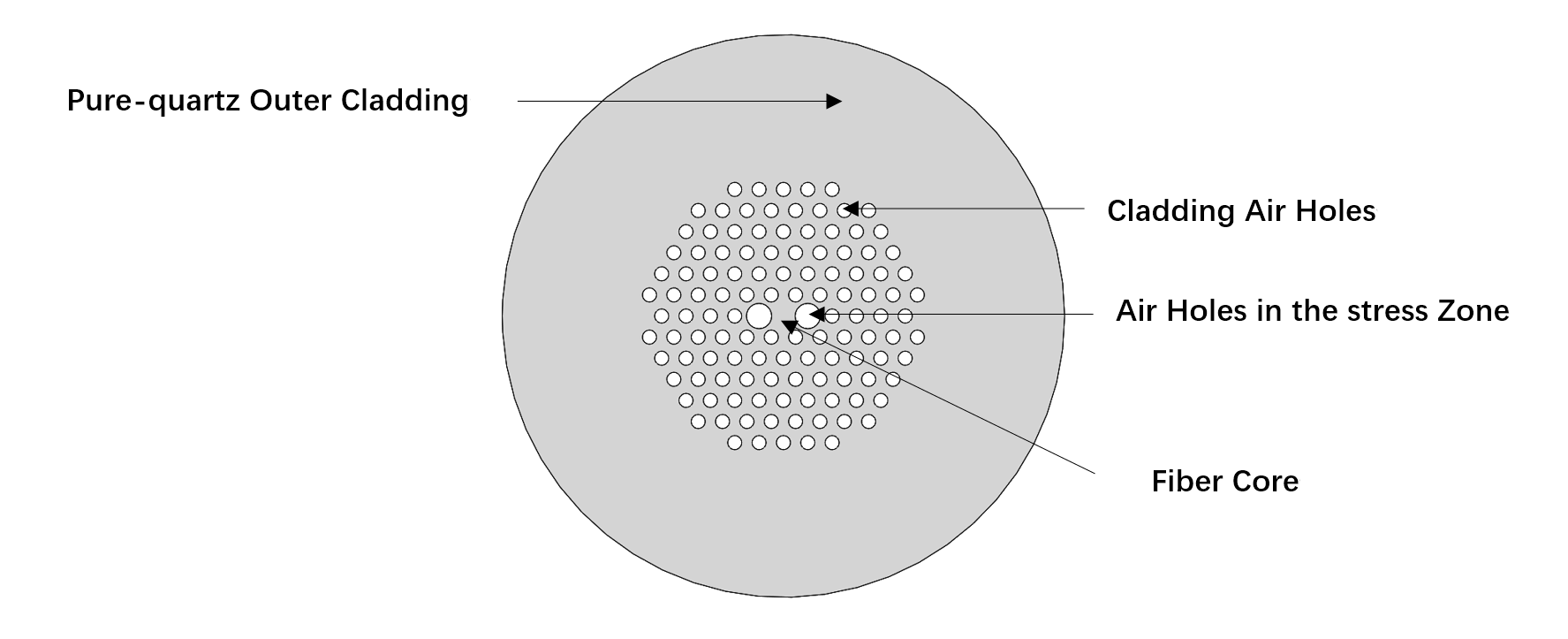
The fiber has a large refractive index step between the air and the glass, which produces strong birefringence, which makes its beat length. Compared with the traditional polarization-maintaining fiber, the polarization-maintaining photonic crystal fiber can reduce the coupling between different polarization states caused by bending and maintain a large extinction ratio.
Product Features
- ✔Good radiation resistance
- ✔The beat length is adjustable
- ✔High birefringence effect
- ✔Good temperature performance
Product Application
- ✔Fiber optic gyroscope
- ✔Polarization device
- ✔Laser
Optical Fiber Structure
Product Specification
| Properties | Unit | Product Type PM-PCF15G-100-U13 |
Product Type PM-PCF15G-125-U25 |
Product Type PM-PCF15G-125-U25 |
Product Type PM-PCF15G-80-U16 |
|---|---|---|---|---|---|
| Optical Properties | |||||
| Working wavelength | μm | 1550 | 1550 | 1550 | 1550 |
| Mode field diameter | μm | 4.1 ± 1.0 | 4.0 ± 1.0 | 4.0 ± 1.0 | 4.0 ± 1.0 |
| Attenuation | dB/km | ≤ 2.0 | ≤ 2.0 | ≤ 2.0 | ≤ 2.0 |
| Beat Length | mm | ≤ 5.0 | ≤ 3.0 | ≤ 3.0 | ≤ 3.0 |
| Typical crosstalk @1550nm(100m) | dB | ≤ -15 | ≤ -30 | ≤ -30 | ≤ -30 |
| Temperature circulation -45℃~85℃ crosstalk fluctuation @1550nm(1Km) | dB | ≤ 2.0 | ≤ 3.0 | ≤ 3.0 | ≤ 3.0 |
| Geometric Properties | |||||
| Cladding diameter | μm | 100.0 ± 1.0 | 125.0 ± 1.0 | 80.0 ± 1.0 | 80.0 ± 1.0 |
| Coating diameter | μm | 135.0 ± 5.0 | 245.0 ± 5.0 | 165.0 ± 5.0 | 165.0 ± 5.0 |
| Cladding out-of-roundness | % | ≤ 1.0 | ≤ 1.0 | ≤ 1.0 | ≤ 1.0 |
Customized Information
- ✔Polarization-maintaining photonic crystal fibers with specific beat lengths and bands can be customized.
- ✔Polarization-maintaining photonic crystal fibers with specific cladding diameter and duty cycle can be customized.
Notices
In order to prevent moisture and dust from entering the hollow microtubule to affect the later performance, both ends of the polarization-maintaining photonic crystal fiber must be sealed.
Advanced Engineering & Technological Superiority
Setting a new benchmark in precision optical engineering, our Polarization-Maintaining Photonic Crystal Fiber (PM-PCF) leverages a distinctive structural geometry. By introducing a massive refractive index step between the precisely engineered air holes and the solid glass matrix, this specialty optical fiber generates an exceptionally high birefringence effect. This advanced microstructure is fundamentally superior to traditional stress-applying part (SAP) designs.
Unlike conventional PM fibers that suffer from thermal stress variations, our PM-PCF maintains extraordinary temperature stability (-45℃~85℃) and unprecedented radiation resistance. The adjustable beat length and resilient structural integrity dramatically reduce the coupling between different polarization states induced by bending. This ensures a remarkably large extinction ratio, rendering it the optimal choice for constructing ultra-precise fiber optic gyroscopes (FOG), advanced polarization devices, and next-generation coherent laser systems deployed in demanding environments.
Polarization-Maintaining Photonic Crystal Fiber Buyer Guide
Polarization-maintaining photonic crystal fiber (PM-PCF) combines a microstructured cladding with strong birefringence to reduce coupling between polarization states. It is intended for polarization-sensitive 1550 nm systems, fiber-optic gyroscopes, laser systems and precision sensing.
How to Select a PM-PCF Model
- Confirm the 1550 nm operating band and source characteristics.
- Select the cladding and coating dimensions that match the handling and component design.
- Review mode-field diameter, attenuation, beat length and crosstalk together.
- Define bend conditions, temperature cycling and required test length.
Information to Include in Your RFQ
- Source wavelength, spectral width and optical power
- Required cladding and coating dimensions
- Beat-length, crosstalk and attenuation targets
- Bend radius, routing and operating-temperature range
- Fiber length, quantity, packaging, documentation and destination
Frequently Asked Questions
How does PM-PCF differ from conventional Panda PM fiber?
PM-PCF uses a microstructured cladding and a large refractive-index contrast to generate strong birefringence, while Panda fiber relies on stress-applying parts. Selection depends on wavelength, bend sensitivity, polarization performance, handling and integration requirements.
Which parameters are most important for PM-PCF selection?
Operating wavelength, mode-field diameter, attenuation, beat length, crosstalk, cladding size, coating size, bend conditions and environmental requirements should be evaluated as a set.
What test information should be specified?
State the required test wavelength and length, crosstalk or extinction target, temperature-cycling conditions, bend or coil setup and any documentation needed with delivery.
Technical inquiry: Sales@opticlumos.com · WhatsApp +86 13871596508