
- Home >
- Products >
- Special optical fiber >
- Hollow Photonic Crystal Fiber (HCPCF)
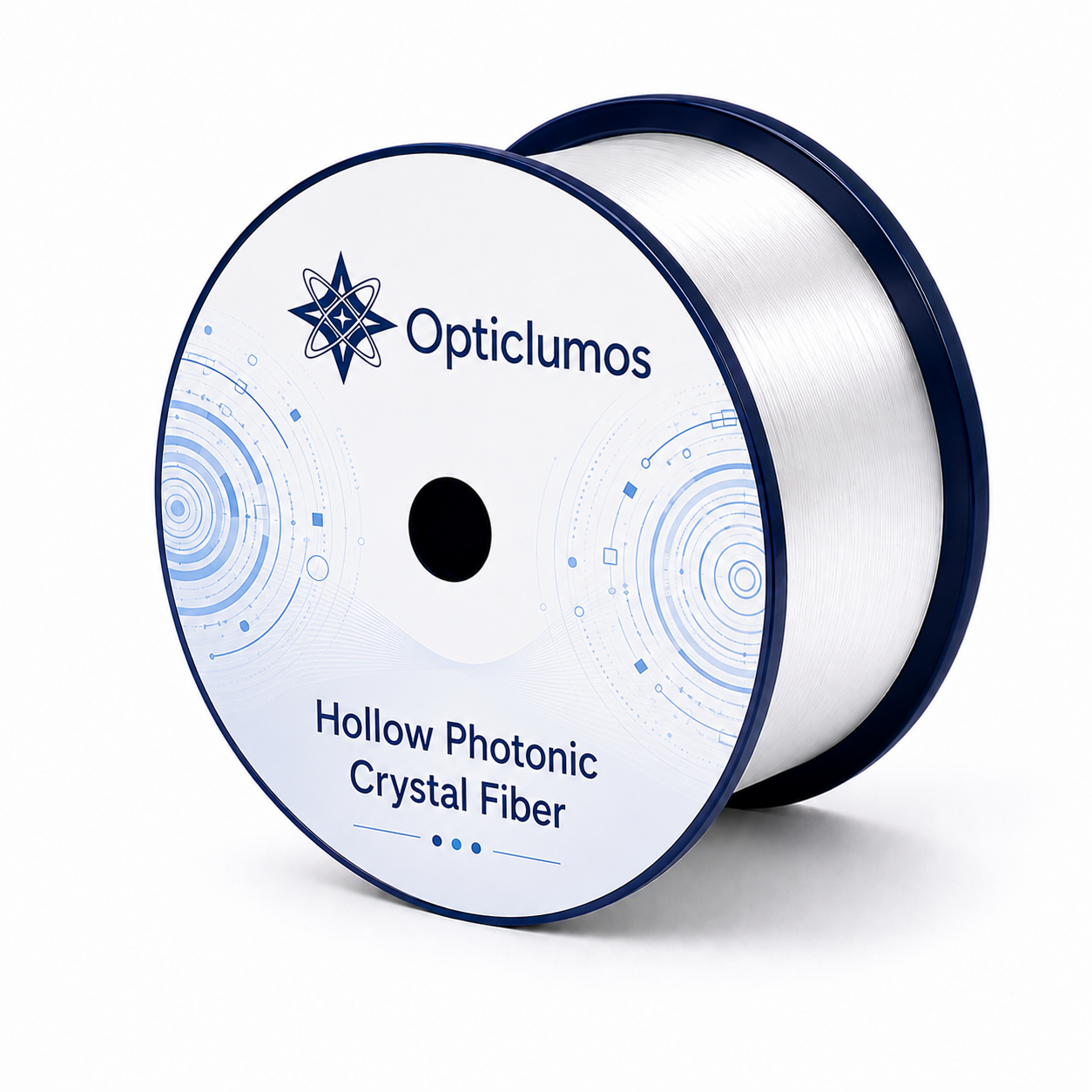
Hollow Photonic Crystal Fiber (HCPCF)
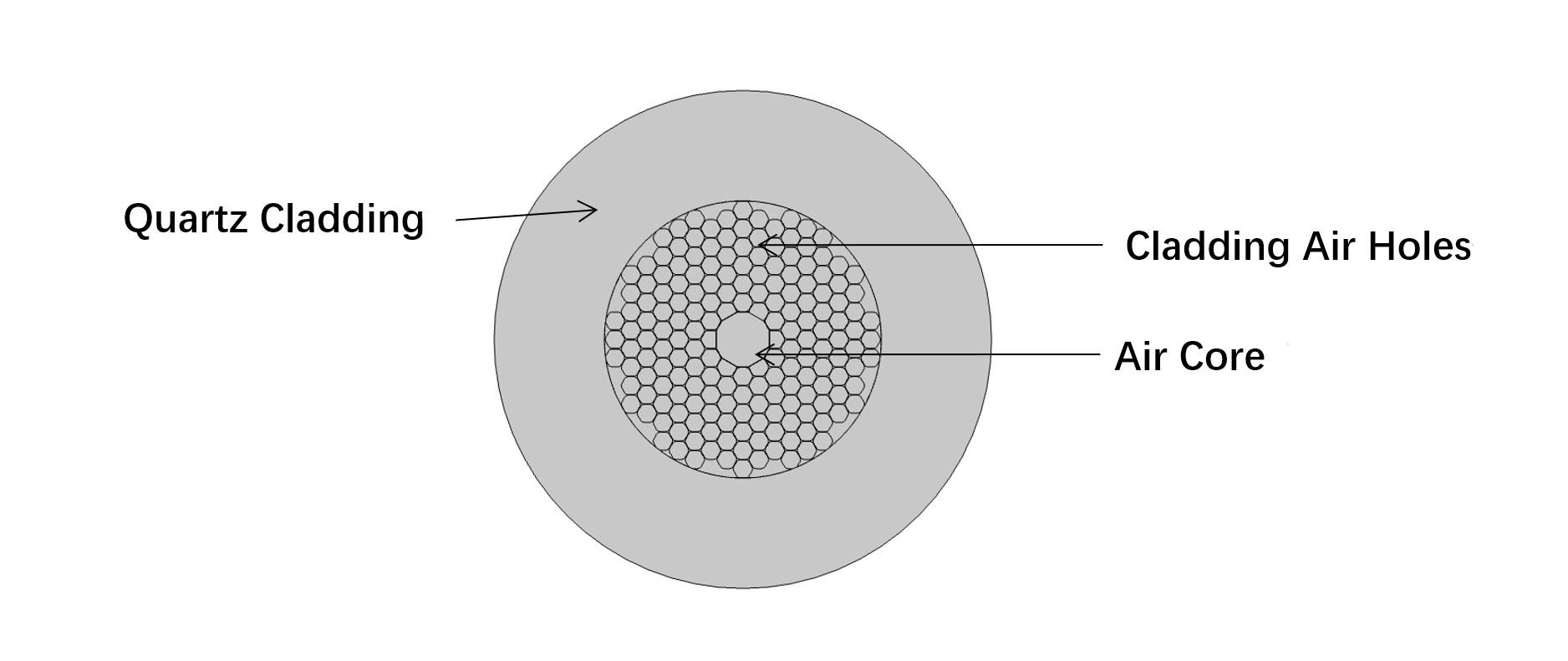
Hollow photonic crystal fiber is composed of two-dimensional photonic crystals arranged periodically, and the core is the air defect of hollow structure. Different from the total internal reflection light guide mechanism of traditional optical fiber, hollow photonic crystal fiber uses photonic bandgap effect to realize light transmission in air.
Most of the optical energy in the optical fiber (more than 95%) is transmitted in the air core, so the optical transmission is less affected by the absorption of optical fiber materials, excellent anti-radiation performance, good thermal stability, and has application advantages in harsh environment. With low nonlinear effect and delay and high damage threshold, it has obvious advantages in the flexible transmission of high power and pulsed laser, and can be used as an efficient platform for the interaction between light and matter.
Product Features
- ✔Low attenuation
- ✔Controllable dispersion
- ✔Low nonlinear effect
- ✔Good radiation resistance
- ✔Good temperature performance
- ✔High damage threshold
Product Application
- ✔Fiber optic gyroscope
- ✔Laser transmission
- ✔Optical fiber sensing
- ✔Nonlinear optics
- ✔Data communication
Optical Fiber Structure
Product Specification
| Properties | Unit | Product Specification HCPCF-130-230-1550 |
Product Specification HCPCF-160-230-1550 |
|---|---|---|---|
| Optical Properties | |||
| Working wavelength | nm | 1490—1650nm | 1490—1650nm |
| Mode field diameter | µm | 7.0±1 | 12.0±2 |
| Attenuation @1550nm | dB/km | ≤10 | ≤10 |
| Geometric Properties | |||
| Cladding diameter | µm | 130±10 | 160±10 |
| Coating diameter | µm | 230±10 | 230±10 |
Notices
In order to prevent moisture and dust from entering the hollow microtubule to affect the later performance, both ends of the polarization-maintaining photonic crystal fiber must be sealed.
Advanced Engineering & Technology Dynamics
Revolutionizing conventional solid-core transmission, our Hollow Photonic Crystal Fiber (HCPCF) represents a major leap in modern optical engineering. By leveraging the photonic bandgap effect instead of total internal reflection, over 95% of optical energy is confined within the air core. This architectural triumph fundamentally eradicates standard material absorption limitations, cementing it as the premier anti-radiation optical fiber capable of maintaining exceptional thermal stability across severely harsh environments.
This engineered internal microstructure not only guarantees a remarkably low nonlinear effect and minimal latency, but it also establishes an astonishingly high damage threshold. These parameters make our HCPCF the definitive medium for the flexible delivery of ultra-high power and pulsed laser transmission. Designed to cater to top-tier industrial demands, it is currently the platform of choice for cutting-edge fiber optic sensing, highly precise fiber optic gyroscopes, nonlinear optics experimentation, and high-fidelity data communication networks.
Hollow-Core Photonic Crystal Fiber Buyer Guide
Hollow-core photonic crystal fiber (HCPCF) guides most optical energy through an air core rather than solid glass. This structure supports low nonlinearity, reduced material interaction and application-specific dispersion control for laser delivery, sensing, nonlinear optics and harsh-environment research.
How to Select an HCPCF Model
- Confirm the operating band; the listed models cover 1490–1650 nm.
- Match the required mode-field diameter to the launch optics and coupling arrangement.
- Review cladding diameter, coating diameter, attenuation and bend conditions.
- Define optical power, pulse duration and repetition rate for laser-delivery projects.
- Plan sealing, termination and handling to protect the hollow microstructure from moisture and dust.
Information to Include in Your RFQ
- Operating wavelength, source type and optical power
- Pulse duration and repetition rate when applicable
- Required mode-field diameter and fiber length
- Bend radius, routing and environmental conditions
- Termination, sealing, test documentation, quantity and destination
Frequently Asked Questions
Why use hollow-core fiber instead of conventional solid-core fiber?
Guiding light mainly in an air core can reduce glass-related nonlinearity and material absorption. The practical benefit depends on wavelength, loss, bend radius, launch conditions and the complete optical system.
What precautions are required when handling HCPCF?
The hollow microstructure should be protected from moisture, dust and contamination. Cleaving, sealing, coupling and termination procedures must be planned for the selected fiber and application.
What source data is needed for laser-delivery evaluation?
Please provide wavelength, average and peak power, pulse duration, repetition rate, beam quality, launch optics, required length, bend conditions and termination requirements.
Technical inquiry: Sales@opticlumos.com · WhatsApp +86 13871596508