
Distributed temperature and strain sensing starts with a measurement requirement: heat, deformation, or both. A cable suitable for a temperature profile is not automatically suitable for transferring structural strain to the sensing fiber.
Distributed temperature and strain sensing: compare the outputs
The fiber is the sensing medium, while the interrogator provides the optical measurement and processing. The measurement principle matters as much as cable survival. A mechanically robust jacket does not establish strain-transfer accuracy, and a fine sampling interval does not by itself establish the smallest event that can be resolved.
| Requirement | Typical approach | Cable-design priority | Question for the system supplier |
|---|---|---|---|
| Temperature profile | Raman DTS | Thermal response, optical loss and environmental durability | Which fiber, wavelength, calibration and installation conditions support the required uncertainty? |
| Quasi-static strain profile | Brillouin-based DSS, or another qualified strain technique | Transfer of host deformation into the fiber | How is temperature cross-sensitivity removed, and what is the installed strain-transfer response? |
| Temperature and strain together | A combined measurement or independent reference channels | Known coupling and a documented separation method | Which outputs are directly measured, which are compensated, and how are the results validated? |
| Dynamic vibration or acoustic events | A suitable distributed acoustic sensing system | Application-specific dynamic coupling | Does the instrument deliver the required dynamic signal, rather than a static temperature or strain result? |
Yokogawa’s DTS technology overview explains Raman temperature measurement. Its Brillouin strain and temperature research addresses separation of the two quantities. These references explain measurement principles; their instrument specifications are not specifications for an Opticlumos cable.
Why temperature and strain cables can need different construction
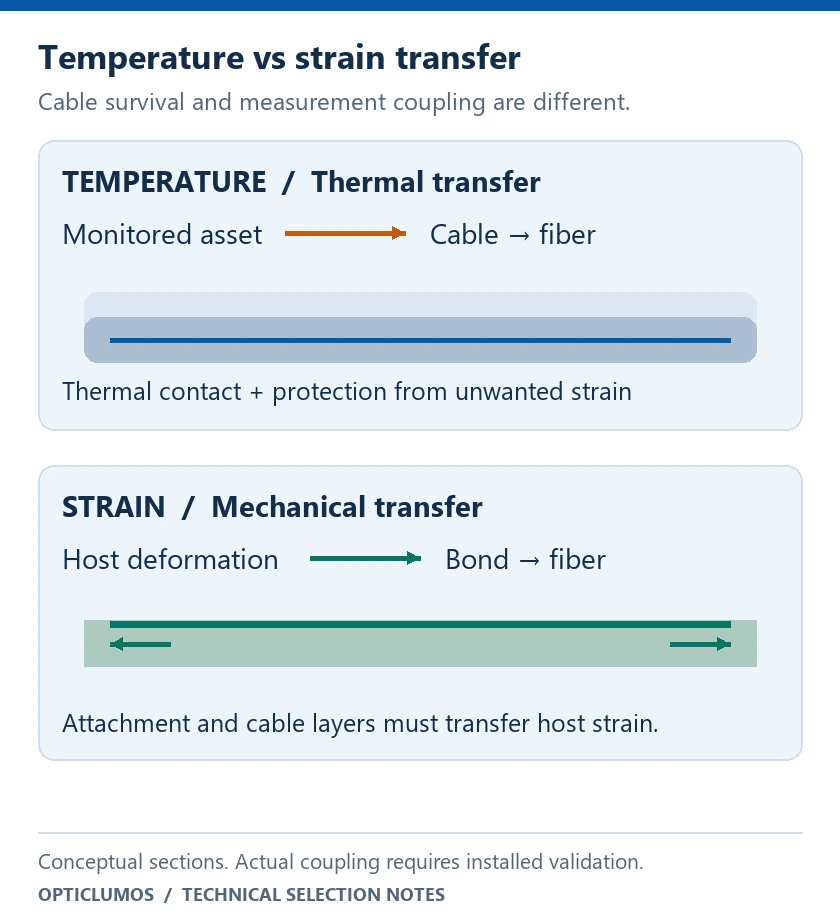
For temperature monitoring, the design often aims to protect the fiber from installation loads while maintaining adequate thermal contact with the monitored asset. For strain measurement, deformation must reach the fiber in a controlled and repeatable way. A loose fiber inside a protective tube can survive an installation yet fail to track the host material’s strain as intended.
Temperature: monitored asset → thermal contact → cable layers → sensing fiber
Strain: host deformation → attachment → cable layers → sensing fiber
Conceptual selection diagram. Actual response depends on construction, installation and calibration.
Ask how the jacket, strength members, buffer, coating and attachment work together. For a bonded strain installation, adhesive choice, bond length, surface preparation and curing conditions belong in the installation procedure. For a temperature installation, burial depth, contact pressure, air gaps and protective layers can affect the measured response.
Do not select a tighter mechanical coupling merely because it sounds more sensitive. The target measurement may require strain isolation. Conversely, do not assume that an armored temperature cable will measure host strain simply because the armor is strong. Validate the completed installation, including its attachment to the asset.
Temperature compensation is part of the strain measurement
A change in a Brillouin signal can include contributions from temperature and strain. A conceptual local relationship is:
ΔνB ≈ CTΔT + CεΔε
The coefficients depend on the fiber and calibration conditions. This relationship illustrates cross-sensitivity; it is not a calibration equation with universal coefficients.
To obtain strain, the system needs sufficient information to distinguish those contributions. Options can include an independent temperature measurement or a qualified multi-parameter measurement method. Silixa’s CCUS sensing white paper discusses independent Raman temperature correction and the importance of strain coupling.
A reference is useful only if it represents the temperature of the strain-sensing location over the relevant time interval. Document how reference and sensing routes correspond. Check what happens at splices, anchor points, free sections, thermal transitions and zones where the two cables follow different paths.

A practical selection workflow
- Write the decision the measurement must support. Examples include locating a cable hot spot, tracking slow structural movement, or distinguishing thermal expansion from mechanical loading. Define the required output before choosing a product.
- Confirm the instrument interface. Obtain the interrogator model, qualified fiber type, optical budget, connector specification and permitted route topology. Do not assume that one fiber type is universal across all sensing systems.
- Describe the installation. Provide route length, bends, pulling conditions, attachment method, ambient and process temperature, pressure, moisture and chemical exposure.
- Separate performance requirements. Specify measurement uncertainty, spatial resolution, sampling interval, acquisition time and response time individually. Ask for the conditions under which each value is achievable.
- Agree on validation. Define factory checks and an installed trial with known thermal or mechanical conditions. Record the baseline and establish an acceptable drift or recheck procedure.
For temperature-only projects, start with our DTS cable selection guide. For route preparation, splicing and commissioning documentation, see the DTS installation guide. Review high-temperature cable materials when thermal exposure constrains the construction.
RFQ checklist for a sensing cable project
| RFQ item | Provide this information | Why it matters |
|---|---|---|
| Measurement and instrument | Temperature, strain or combined output; interrogator model and qualified fiber specification | Prevents selecting a survivable cable that cannot deliver the intended signal. |
| Mechanical coupling | Loose, bonded, embedded or clamped route; drawings and attachment procedure | Defines how the measured asset transfers its behavior to the fiber. |
| Environment | Temperature range, pressure, fluids, hydrogen exposure where relevant, crush and tensile conditions | Supports material and construction review. |
| Optical route | Length, joints, connectors, splice allowance and required access at each end | Allows the system supplier to review loss and topology. |
| Acceptance | Optical baseline, measurement trial, uncertainty target, report format and drawing revision | Makes factory and installed acceptance repeatable. |
Compare available constructions in our fiber optic cable directory and the oil-well temperature-sensing cable page. Those pages describe cable options, not a promise of a complete interrogator system or a qualified strain-sensing assembly. Confirm any strain-coupled design and instrument compatibility during engineering review.
Frequently asked questions
Does a DTS cable measure pressure directly?
Not by itself. A Raman DTS system measures a temperature profile. Pressure measurement needs a suitable sensing mechanism or separately validated model; pressure resistance is a cable-environment rating, not a pressure-sensor specification.
Can one cable contain both temperature and strain fibers?
It may be possible, but the construction must provide the intended coupling and reference arrangement. Confirm the fiber allocation, instrument support and calibration rather than assuming every multicore cable provides both measurements.
Is sampling interval the same as spatial resolution?
No. Sampling interval is the spacing between reported data points. Spatial resolution describes the ability to distinguish a change over distance under stated test conditions. Request both values and the associated measurement settings.
Can laboratory accuracy be used as the installed-system guarantee?
Only when the stated conditions and acceptance method cover the installed system. Cable coupling, environmental gradients, optical losses and calibration can alter practical performance.
Prepare a sensing cable specification
Send the interrogator requirements, measurement objective, route drawing and environmental limits. Opticlumos can review cable construction options and quotation requirements with your system team.
Request a technical quote