
OM1 Multimode Fiber (62.5/125 µm) for LAN & Industrial Networks
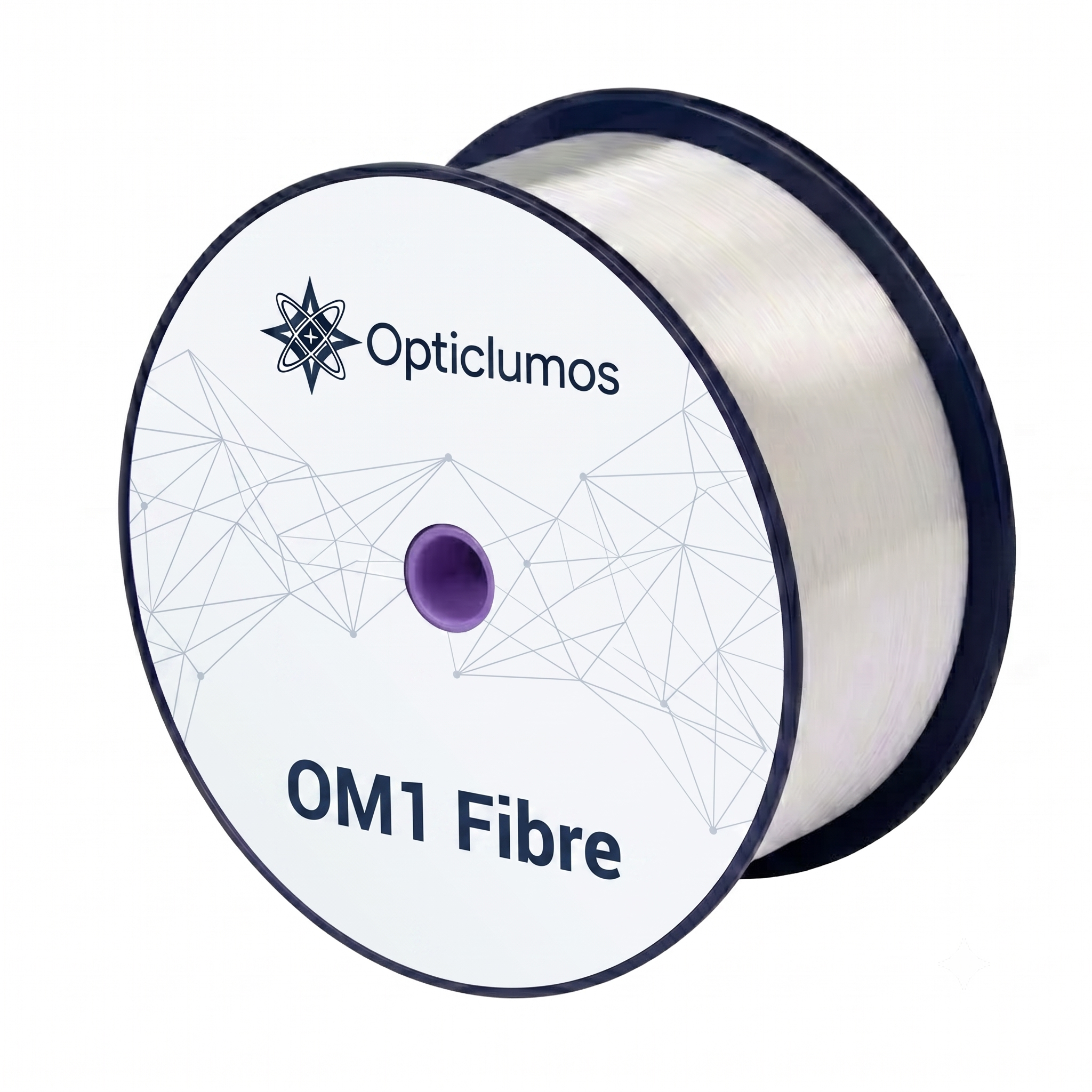
OM1 multimode fiber is a 62.5/125 µm graded-index optical fiber for installed LAN, premises and industrial-control networks. It is mainly specified when compatibility with an existing OM1 link is more important than migration to a newer 50/125 µm laser-optimized grade.
The fiber meets or exceeds ISO/IEC 11801-1 OM1, IEC 60793-2-10 A1-OM1 and TIA-492AAAF A1-OM1 requirements. PCVD profile control and a dual-layer UV-curable acrylate coating support geometry uniformity, microbending resistance and stable tight-buffer processing.
Request an OM1 Fiber Quote View technical specifications ↓
Key Benefits and Applications
- Installed-network compatibility: suitable for maintenance, extension and replacement in 62.5/125 µm OM1 infrastructure.
- Defined optical performance: specified attenuation and bandwidth at both 850 nm and 1300 nm.
- LAN and industrial use: supports video, voice and data links when the transceiver, connector loss, splice loss and total link budget are verified.
- Stable processing: controlled geometry and dual-layer coating support cabling and tight-buffer applications.
Detailed Technical Specifications
| Characteristics | Conditions | Specified Values | Units |
|---|---|---|---|
| Geometry Characteristics | |||
| Core Diameter | - | 62.5 ± 2.5 | µm |
| Core Non-Circularity | - | ≤ 5.0 | % |
| Cladding Diameter | - | 125.0 ± 1.0 | µm |
| Cladding Non-Circularity | - | ≤ 1.0 | % |
| Coating Diameter | - | 245 ± 7 | µm |
| Coating/Cladding Concentricity Error | - | ≤ 10.0 | µm |
| Coating Non-Circularity | - | ≤ 6.0 | % |
| Core/Cladding Concentricity Error | - | ≤ 1.5 | µm |
| Delivery Length | - | up to 17.6 | km/reel |
| Optical Characteristics | |||
| Attenuation | 850nm 1300nm |
≤ 2.7 ≤ 0.6 |
dB/km dB/km |
| Overfilled Modal Bandwidth | 850nm 1300nm |
≥ 200 ≥ 500 |
MHz·km MHz·km |
| Numerical Aperture | - | 0.275 ± 0.015 | - |
| Group Refractive Index | 850nm 1300nm |
1.496 1.491 |
- |
| Zero Dispersion Wavelength, λ₀ | - | 1320 - 1365 | nm |
| Zero Dispersion Slope, S₀ | 1320nm ≤ λ₀ ≤ 1348nm 1348nm < λ₀ ≤ 1365nm |
≤ 0.11 ≤ 0.001(1458-λ₀) |
ps/(nm²·km) ps/(nm²·km) |
| Macrobending Loss | |||
| 100 Turns @ 37.5 mm Radius | 850nm 1300nm |
≤ 0.50 ≤ 0.50 |
dB dB |
| Backscatter Characteristics (1300nm) | |||
| Step (Mean of Bidirectional Measurement) | - | ≤ 0.10 | dB |
| Irregularities Over Fibre Length and Point Discontinuity | - | ≤ 0.10 | dB |
| Attenuation Uniformity | - | ≤ 0.10 | dB/km |
| Environmental Characteristics (850nm & 1300nm) | |||
| Temperature Cycling | -60°C to 85°C | ≤ 0.10 | dB/km |
| Temperature-Humidity Cycling | -10°C to 85°C, 4% to 98% RH | ≤ 0.10 | dB/km |
| Water Immersion | 23°C, 30 days | ≤ 0.10 | dB/km |
| Dry Heat | 85°C, 30 days | ≤ 0.10 | dB/km |
| Damp Heat | 85°C, 85% RH, 30 days | ≤ 0.10 | dB/km |
| Mechanical Specification | |||
| Proof Test | - | ≥ 9.0 | N |
| - | ≥ 1.0 | % | |
| - | ≥ 100 | kpsi | |
| Coating Strip Force | typical average force peak force |
1.5 ≥ 1.3, ≤ 8.9 |
N N |
| Dynamic Stress Corrosion Susceptibility Parameter (nd typical) | - | 20 | - |
OM1 Multimode Fiber Selection Guide
Choose OM1 for compatibility with an installed 62.5/125 µm network. For a new high-speed link, compare the transceiver specification and reach requirement with newer 50/125 µm grades before final selection.
| Fiber grade | Core/cladding | Typical selection reason |
|---|---|---|
| OM1 | 62.5/125 µm | Maintenance or extension of installed OM1 networks |
| OM2 | 50/125 µm | Compatibility with installed OM2 infrastructure |
| OM3 / OM4 | 50/125 µm | Laser-optimized designs for newer high-speed links |
For core size, bandwidth and upgrade decisions, read the OM1 vs OM2 vs OM3 vs OM4 multimode fiber comparison. For link-loss planning, see our fiber optic attenuation guide. Browse the complete communication optical fiber range.
Information to Include in Your RFQ
- Whether you need bare OM1 fiber, buffered fiber or a finished cable
- Operating wavelength, data rate, transceiver type and required link distance
- Connector and splice count, allowable link budget and test requirements
- Order length, packaging, quantity, destination and applicable standard
Frequently Asked Questions
Is OM1 fiber obsolete?
No. OM1 remains relevant for maintaining, extending or replacing parts of installed 62.5/125 µm networks. For a new high-speed project, OM3 or OM4 may offer a better migration path.
Is this bare OM1 fiber or OM1 fiber optic cable?
This page specifies OM1 optical fiber. Finished cable construction, buffering, connectorization and environmental protection are project-specific and should be stated in the RFQ.
Can OM1 be mixed with 50/125 µm multimode fiber?
Mixing different core sizes can add coupling loss and performance uncertainty. Match the installed fiber grade wherever possible and review the complete link design before deployment.
What information is needed to confirm link performance?
Provide wavelength, data rate, transceiver type, link distance, connector and splice count, and the acceptable optical link budget.
Technical inquiry: sales@opticlumos.com · WhatsApp +86 13871596508