
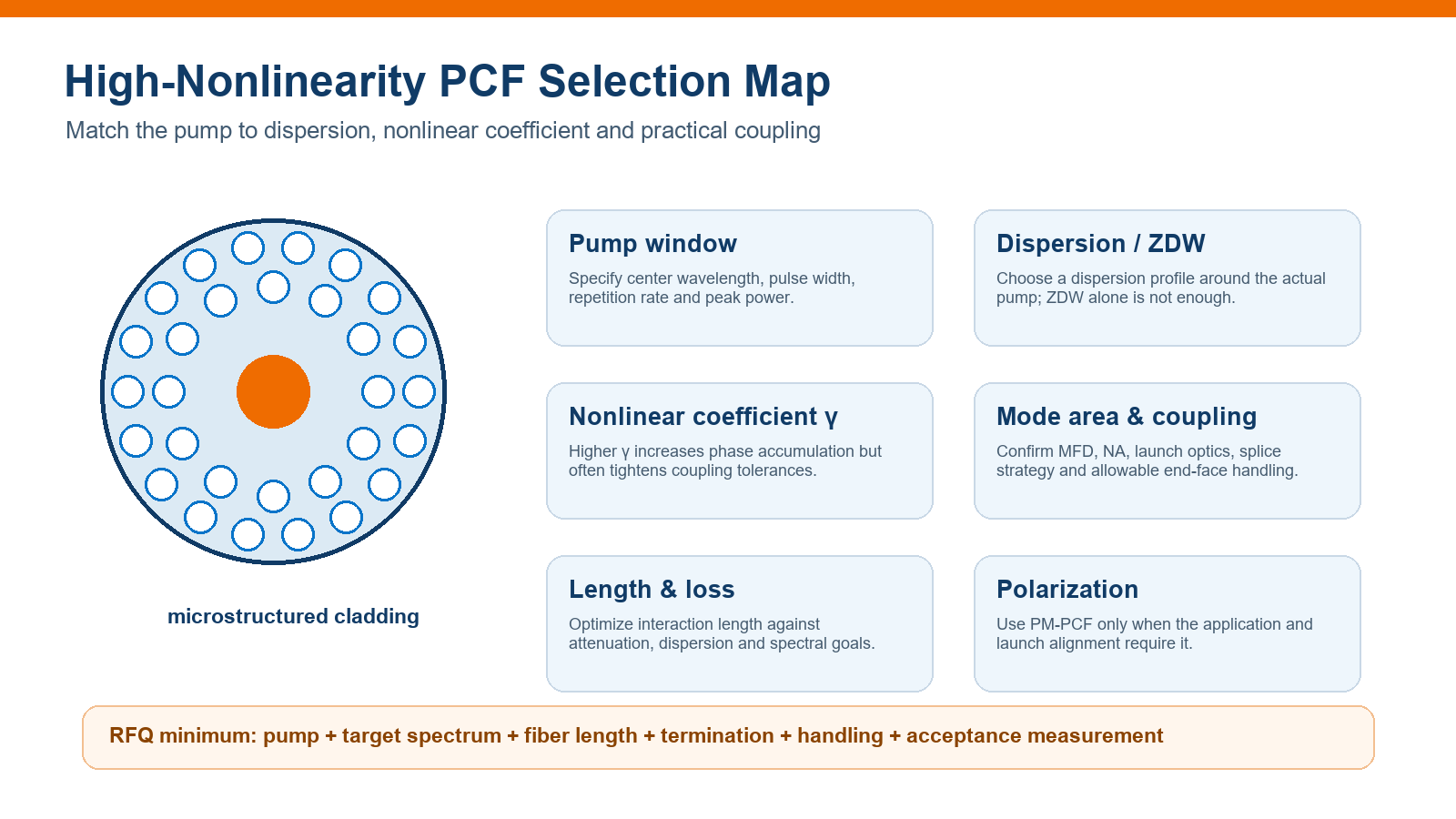
High-nonlinearity photonic crystal fiber is selected as part of a pump–fiber–length system. A high nonlinear coefficient is useful only when dispersion, coupling, polarization, attenuation, damage limits and the target spectrum are considered together.
What makes a photonic crystal fiber highly nonlinear?
In a typical solid-core nonlinear PCF, a small silica core is surrounded by a microstructured cladding containing air holes. The geometry can confine light to a small effective mode area and can tailor waveguide dispersion. Both effects are valuable: high optical intensity strengthens nonlinear interaction, while the dispersion profile controls phase matching and the way pulse energy evolves with wavelength.
This is a more specific purchasing problem than choosing among general photonic crystal fiber types. If the first decision is solid-core versus hollow-core guidance, use the solid-core vs hollow-core PCF comparison. If the goal is spectral broadening, nonlinear conversion or frequency-comb research, start with the pump and nonlinear parameters below.
Nonlinear coefficient γ and effective mode area
The fiber nonlinear coefficient is commonly expressed as γ = 2πn₂/(λAeff). For a given glass and wavelength, reducing effective mode area increases γ and therefore the nonlinear phase accumulated for a given peak power and length. The relationship explains why a microstructured fiber with a small core can produce strong effects in a compact length.
A larger γ is not automatically the best choice. A very small mode can increase sensitivity to launch alignment, end-face contamination, splice mismatch and local intensity. It may also change the balance between useful broadening, stimulated Raman scattering, four-wave mixing, self-phase modulation and unwanted damage or instability. Ask how γ was calculated or measured, and at which wavelength.
Dispersion, zero-dispersion wavelength and slope
Zero-dispersion wavelength (ZDW) marks a sign change in group-velocity dispersion, but a single ZDW number does not describe the full curve. Pumping in normal or anomalous dispersion can produce different dynamics, and the dispersion slope affects how far new frequencies remain phase matched. Fabrication tolerances can shift the actual curve, especially in small structures.
For supercontinuum generation, pumping near a suitable ZDW often lowers the threshold for broad spectral generation. The optimum detuning and length depend on pulse duration, peak power, coherence requirements and the desired output band. Request the dispersion curve across the relevant wavelength range and clarify whether values are nominal, calculated or measured.
| Parameter | What it controls | RFQ question |
|---|---|---|
| Nonlinear coefficient γ | Nonlinear phase per power and length | Value, unit, wavelength and method? |
| Effective mode area / MFD | Intensity, coupling optics and splice mismatch | Values across the pump and output band? |
| Dispersion D or β₂ | Pulse evolution, phase matching and soliton dynamics | Full curve, sign convention and tolerance? |
| ZDW and dispersion slope | Operating region relative to the pump | Nominal or measured for the supplied length? |
| Attenuation | Effective interaction length and usable output band | Loss at pump and target wavelengths? |
| Polarization behavior | Repeatability and nonlinear interaction | Standard or PM design; required launch axis and extinction target? |
Match the PCF to the real pump source
State center wavelength, tuning range, pulse duration at the fiber input, repetition rate, average power, pulse energy, peak power, beam quality and polarization. Peak power drives many nonlinear processes; average power alone cannot define the interaction. Include the expected launch efficiency and whether the pump is free-space coupled, spliced or delivered by another fiber.
The target output must also be measurable: for example, a continuous spectrum over a stated wavelength interval at a minimum spectral density, a defined frequency-conversion band, pulse compression, or a nonlinear phase shift. “Maximum bandwidth” is not a complete acceptance target because it omits power, uniformity, coherence and stability.
Coupling, end preparation and fiber length
Launch optics
Match the focused spot and numerical aperture to the PCF mode. Protect the end face from dust and avoid focusing on the glass–air structure. Record launch efficiency separately from propagation loss so poor alignment is not mistaken for high fiber attenuation.
Splicing and connectorization
Air-hole collapse, mode mismatch and thermal sensitivity can complicate fusion splicing. Connectorized delivery may simplify handling but can limit power or alter the end condition. Specify whether the fiber should be bare, end-capped, collapsed, spliced to a pigtail or installed in a protective assembly, and request the corresponding loss and power-handling test.
Interaction length
Longer fiber increases nonlinear interaction only until attenuation, dispersion and walk-off limit the useful process. For pulsed systems, model several lengths and order enough material for cutback trials when the final optimum is uncertain. Coil diameter and packaging must remain within the bend-loss and mechanical limits.
Which nonlinear PCF configuration fits the goal?
| Goal | Prioritize | Verify experimentally |
|---|---|---|
| Supercontinuum generation | Pump-relative dispersion, high γ, loss across the generated band | Output spectrum, spectral density, stability and launch efficiency |
| Four-wave mixing / wavelength conversion | Phase matching, dispersion slope, polarization and pump detuning | Conversion band, efficiency and sensitivity to wavelength/power |
| Self-phase modulation or pulse compression | γ, effective length, input chirp and dispersion sign | Spectrum, pulse duration and compressor settings |
| Frequency comb research | Coherence, polarization stability, dispersion uniformity and environmental stability | Line structure, noise and run-to-run repeatability |
| Polarization-sensitive nonlinear optics | PM-PCF birefringence, axis alignment and assembly PER | Output polarization and nonlinear response on the intended axis |
See the high-nonlinearity photonic crystal fiber product page for available custom review. The final fiber geometry, tolerance and delivery format must be matched to the experiment; generic application examples are not guaranteed performance.
High-nonlinearity PCF RFQ checklist
- Pump center wavelength and tuning range
- Pulse duration at launch, repetition rate, pulse energy, peak and average power
- Polarization state and whether PM operation is required
- Target nonlinear process and required output band or measurement
- Required γ, dispersion curve, ZDW, slope, MFD/Aeff, NA and attenuation data
- Fiber length, quantity, cutback samples and packaging/coiling constraints
- Bare, cleaved, collapsed, end-capped, spliced or connectorized delivery
- Launch optics or input fiber, expected coupling efficiency and splice-loss limit
- End-face handling, power ramp procedure and environmental constraints
- Acceptance test setup, data format and tolerances
Frequently asked questions
Is the highest nonlinear coefficient always best?
No. A higher γ can reduce the required power or length, but dispersion, loss, coupling tolerance, mode quality and damage limits may make another design more useful.
Is zero-dispersion wavelength enough to choose a supercontinuum fiber?
No. Use the full dispersion curve and slope together with pump pulse parameters, attenuation, γ and target spectrum.
Can nonlinear PCF be fusion spliced to standard single-mode fiber?
It can be possible, but mode mismatch and air-hole collapse require a qualified process. Ask for expected splice loss and the exact end preparation.
Do I need polarization-maintaining nonlinear PCF?
Use PM-PCF when polarization stability or axis-dependent nonlinear interaction is part of the requirement. It also requires controlled launch-axis alignment.
References
- NKT Photonics nonlinear-fiber datasheet
- NKT Photonics application note on supercontinuum generation
- RP Photonics: highly nonlinear fibers
Need a nonlinear PCF selection review?
Send the pump, pulse parameters, target spectrum, polarization, length, termination and acceptance method. OpticLumos can review a buildable fiber and delivery specification.