
EasyBand® Plus G.657.A2 Bending Insensitive Single-Mode Fiber
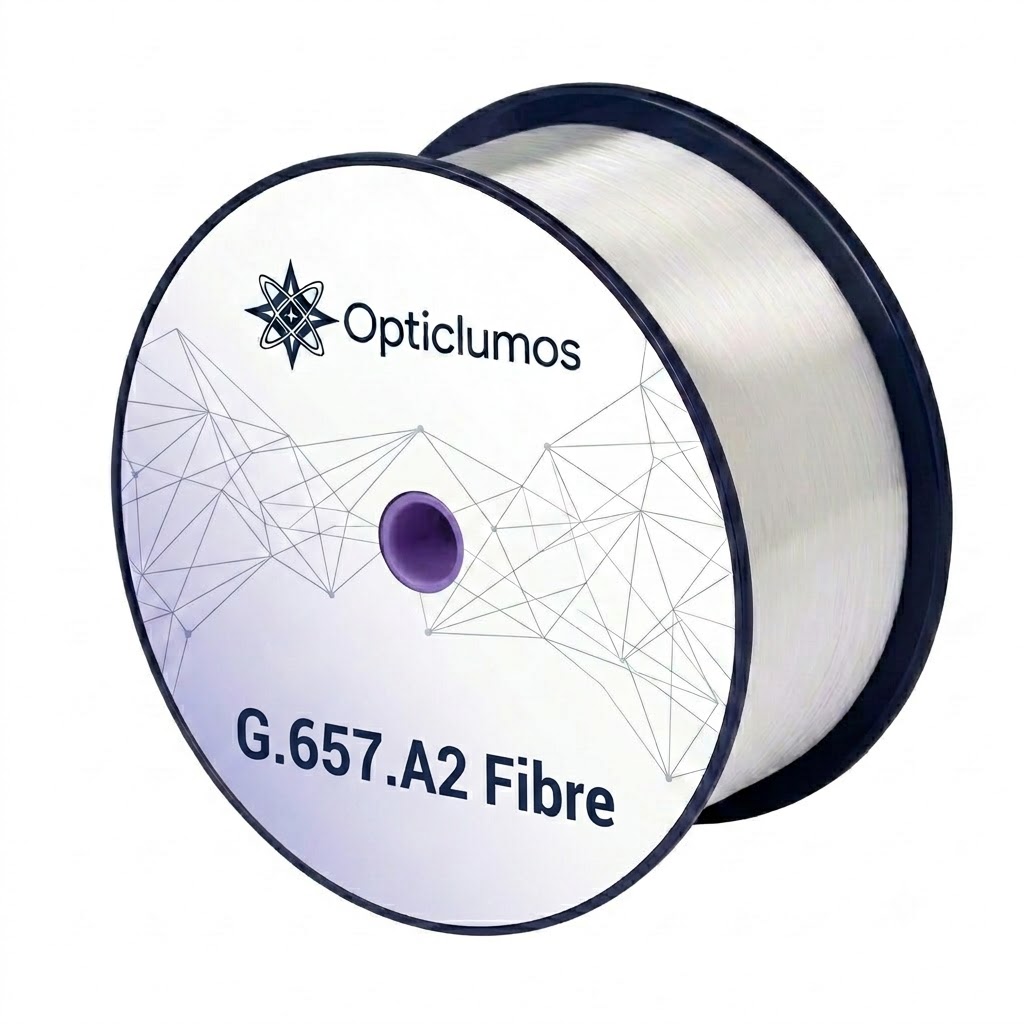
The EasyBand® Plus Bending Insensitive Single-mode Fibre combines two attractive features: excellent low macro-bending sensitivity and a low water-peak level. It is comprehensively optimized for high-performance optical networks operating in the entire O-E-S-C-L band (1260-1625 nm).
The bending insensitive feature of EasyBand® Plus not only guarantees L-band applications but also allows for easy installation without excessive care when storing the fibre, especially for Fibre-to-the-Home (FTTH) networks applications. Bending radii in fibre guidance ports can be significantly reduced, as well as minimum bend radii in wall and corner mountings. It meets or exceeds the stringent ITU-T Recommendation G.652.D/G.657.A1/G.657.A2/G.657.B2 and the IEC 60793-2-50 type B1.3/B6.a1/B6.a2/B6.b2 Optical Fiber Specifications.
Key Characteristics & Applications
- ✔Extremely high bending loss resistance in the 7.5 to 15mm bending radius range.
- ✔Full compatibility with all G.652 fibres for any applications, with accurate geometrical parameters ensuring low splicing loss.
- ✔Ideal for high-speed optical routes in FTTH networks, extreme low bending requirement cables, and small-sized fibre optical components.
Detailed Technical Specifications
| Characteristics | Conditions | Specified Values | Units |
|---|---|---|---|
| Optical Characteristics | |||
| Cable Cutoff Wavelength (λcc) | - | ≤ 1260 | nm |
| Attenuation | 1310nm | ≤ 0.35 | dB/km |
| 1383nm (after H2-aging) | ≤ 0.35 | dB/km | |
| 1460nm | ≤ 0.25 | dB/km | |
| 1490nm | ≤ 0.23 | dB/km | |
| 1550nm | ≤ 0.21 | dB/km | |
| 1625nm | ≤ 0.23 | dB/km | |
| Attenuation vs. Wavelength Max. α difference |
1285-1330nm, in reference to 1310nm 1525-1575nm, in reference to 1550nm |
≤ 0.03 ≤ 0.02 |
dB/km dB/km |
| Zero Dispersion Wavelength (λ0) | - | 1300 - 1324 | nm |
| Zero Dispersion Slope (S0) | - | ≤ 0.092 | ps/(nm²·km) |
| PMD | Maximum Individual Fibre | ≤ 0.1 | ps/√km |
| Link Design Value (M=20, Q=0.01%) | ≤ 0.06 | ps/√km | |
| Typical Value | 0.04 | ps/√km | |
| Mode Field Diameter (MFD) | 1310nm | 8.4 - 9.2 | µm |
| 1550nm | 9.3 - 10.3 | µm | |
| Effective Group Index of Refraction (Neff) | 1310nm | 1.466 | - |
| 1550nm | 1.467 | - | |
| Point Discontinuities | 1310nm | ≤ 0.05 | dB |
| 1550nm | ≤ 0.05 | dB | |
| Geometrical Characteristics | |||
| Cladding Diameter | - | 125.0 ± 0.7 | µm |
| Cladding Non-Circularity | - | ≤ 0.7 | % |
| Coating Diameter | - | 235 - 245 | µm |
| Coating-Cladding Concentricity Error | - | ≤ 12.0 | µm |
| Coating Non-Circularity | - | ≤ 6.0 | % |
| Core-Cladding Concentricity Error | - | ≤ 0.5 | µm |
| Curl (radius) | - | ≥ 4 | m |
| Delivery Length | - | Up to 50.4 | km/reel |
| Environmental Characteristics (1310nm, 1550nm & 1625nm) | |||
| Temperature Dependence Induced Attenuation | -60°C to +85°C | ≤ 0.05 | dB/km |
| Temperature-Humidity Cycling Induced Attenuation | -10°C to +85°C, 98% RH | ≤ 0.05 | dB/km |
| Watersoak Dependence Induced Attenuation | 23°C, for 30 days | ≤ 0.05 | dB/km |
| Damp Heat Dependence Induced Attenuation | 85°C and 85% RH, for 30 days | ≤ 0.05 | dB/km |
| Dry Heat Aging | 85°C, for 30 days | ≤ 0.05 | dB/km |
| Mechanical Specifications | |||
| Proof Test | - | ≥ 9.0 | N |
| - | ≥ 1.0 | % | |
| - | ≥ 100 | kpsi | |
| Macro-bend Induced Loss | 10 Turns Around a Mandrel of 15 mm Radius (1550nm) | ≤ 0.03 | dB |
| 10 Turns Around a Mandrel of 15 mm Radius (1625nm) | ≤ 0.1 | dB | |
| 1 Turn Around a Mandrel of 10 mm Radius (1550nm) | ≤ 0.1 | dB | |
| 1 Turn Around a Mandrel of 10 mm Radius (1625nm) | ≤ 0.2 | dB | |
| 1 Turn Around a Mandrel of 7.5 mm Radius (1550nm) | ≤ 0.5 | dB | |
| 1 Turn Around a Mandrel of 7.5 mm Radius (1625nm) | ≤ 1.0 | dB | |
| Coating Strip Force | Typical average force | 1.5 | N |
| Peak force | 1.3 - 8.9 | N | |
| Dynamic Fatigue Parameter (nd) | - | ≥ 20 | - |
G.657.A2 Bend-Insensitive Fiber Buyer Guide
EasyBand® Plus G.657.A2 single-mode fiber is intended for FTTH, access networks, indoor cabling and compact routes where macro-bending performance matters. It combines bend resistance with compatibility for standard single-mode network designs.
Information to Include in Your RFQ
- G.657.A2 standard and operating wavelength
- Minimum bend radius and cable design
- Attenuation target, coating diameter and test requirements
- Order length, packaging, quantity and destination
Frequently Asked Questions
Where is G.657.A2 normally used?
Typical applications include FTTH drop networks, indoor routing, compact closures and cable designs that experience tighter bends.
Is G.657.A2 compatible with G.652.D networks?
It is designed for broad compatibility with standard single-mode systems, but splice, cable and system requirements should be confirmed for each project.
What should I specify for bend performance?
Provide the minimum bend radius, cable construction, operating wavelength and applicable test standard so the correct fiber can be reviewed.
Technical inquiry: sales@opticlumos.com · WhatsApp +86 13871596508