
FullBand® G.652.D Low Water Peak Single-Mode Fiber for Advanced Communication
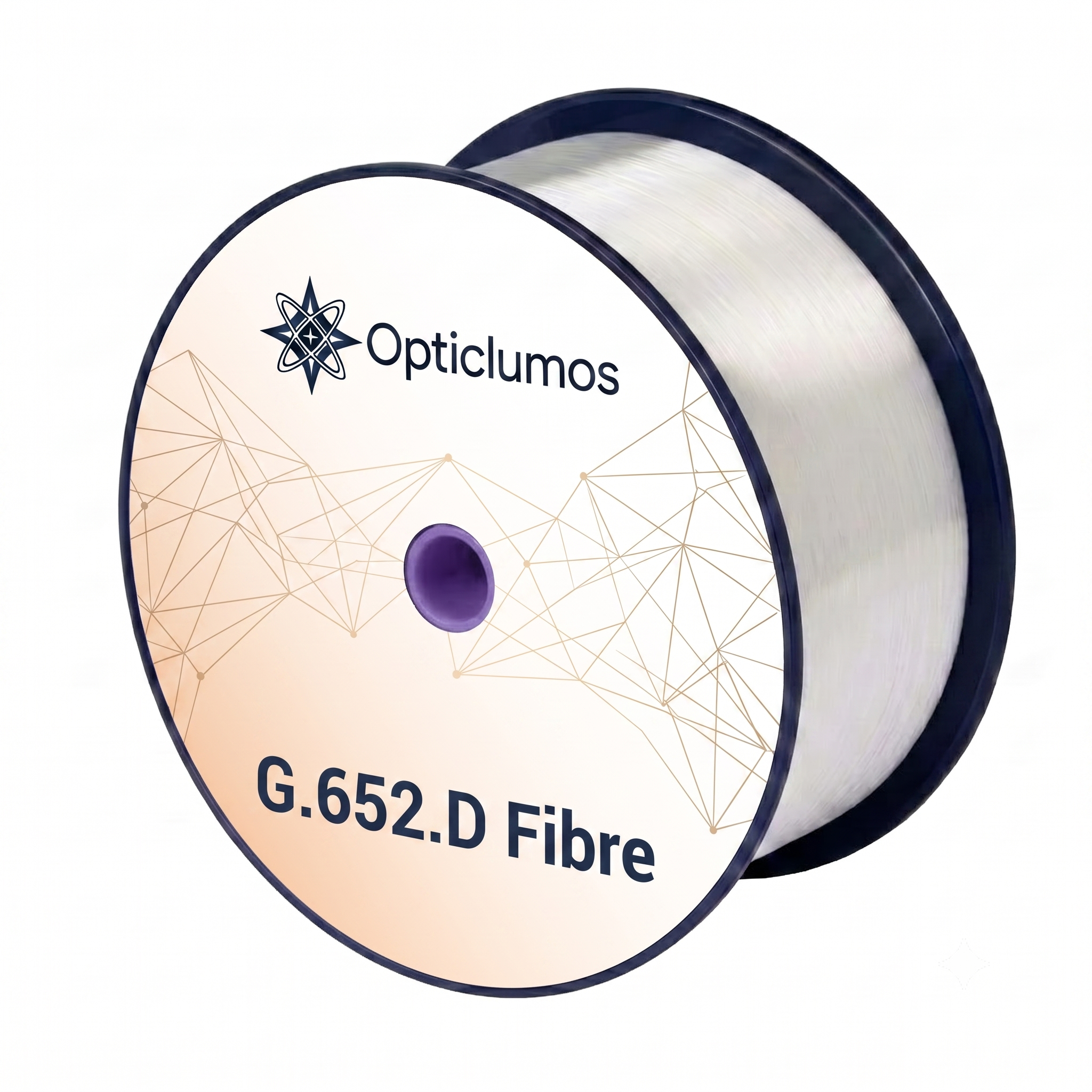
The FullBand® low water peak dispersion unshifted single-mode fibre is engineered specifically for advanced optical transmission systems operating over the entire wavelength window from 1260 nm to 1625 nm. By suppressing the water peak that traditionally occurs near 1383 nm due to hydroxyl (OH-) ions absorption, the FullBand® fibre opens the E-band (1360-1460nm) for seamless operation, consequently providing 100 nm more usable wavelengths.
Thanks to its broad usable optical spectrum and outstanding optical performance, this single-mode fiber complies with and exceeds the stringent requirements of the ITU-T Recommendation G.652.D and the IEC 60793-2-50 type B1.3 specifications. It is the optimum choice supporting various high-speed applications such as Ethernet, Internet Protocol (IP), Asynchronous Transfer Mode (ATM), Synchronous Optical Network (SONET), and Wavelength Division Multiplexing (WDM).
Key Characteristics & Advantages
- ✔Designed for operation over the full optical spectrum from 1260-1625 nm, providing 50% more usable wavelengths.
- ✔Outstanding optical performance supporting high-speed transmission technologies such as DWDM and CWDM.
- ✔Fully compatible with existing 1310 nm equipment for easy integration.
- ✔Accurate geometrical parameters ensuring extremely low splicing loss and high splicing efficiency.
Detailed Technical Specifications
| Characteristics | Conditions | Specified Values | Units |
|---|---|---|---|
| Optical Characteristics | |||
| Attenuation | 1310nm | ≤ 0.34 | dB/km |
| 1383nm (after H2-aging) | ≤ 0.34 | dB/km | |
| 1550nm | ≤ 0.20 | dB/km | |
| 1625nm | ≤ 0.24 | dB/km | |
| Attenuation vs. Wavelength Max. α difference |
1285-1330nm, in reference to 1310nm 1525-1575nm, in reference to 1550nm |
≤ 0.03 ≤ 0.02 |
dB/km dB/km |
| Dispersion Coefficient | 1285-1340nm | -3.5 to 3.5 | ps/(nm·km) |
| 1550nm | ≤ 18 | ps/(nm·km) | |
| 1625nm | ≤ 22 | ps/(nm·km) | |
| Zero Dispersion Wavelength (λ0) | - | 1300 - 1324 | nm |
| Zero Dispersion Slope (S0) | - | ≤ 0.092 | ps/(nm²·km) |
| PMD | Typical Value | 0.086 | ps/√km |
| Maximum Individual Fibre | ≤ 0.1 | ps/√km | |
| Link Design Value (M=20, Q=0.01%) | ≤ 0.06 | ps/√km | |
| Cable Cutoff Wavelength (λcc) | - | ≤ 1260 | nm |
| Mode Field Diameter (MFD) | 1310nm | 8.7 - 9.5 | µm |
| 1550nm | 9.8 - 10.8 | µm | |
| Effective Group Index of Refraction (Neff) | 1310nm | 1.466 | - |
| 1550nm | 1.467 | - | |
| Point Discontinuities | 1310nm | ≤ 0.05 | dB |
| 1550nm | ≤ 0.05 | dB | |
| Geometrical Characteristics | |||
| Cladding Diameter | - | 125.0 ± 0.7 | µm |
| Cladding Non-Circularity | - | ≤ 1.0 | % |
| Coating Diameter | - | 235 - 250 | µm |
| Coating-Cladding Concentricity Error | - | ≤ 12.0 | µm |
| Coating Non-Circularity | - | ≤ 6.0 | % |
| Core-Cladding Concentricity Error | - | ≤ 0.6 | µm |
| Curl (radius) | - | ≥ 4 | m |
| Delivery Length | - | Up to 50.4 | km/reel |
| Environmental Characteristics (1310nm, 1550nm & 1625nm) | |||
| Temperature Dependence Induced Attenuation | -60°C to +85°C | ≤ 0.05 | dB/km |
| Temperature-Humidity Cycling Induced Attenuation | -10°C to +85°C, 98% RH | ≤ 0.05 | dB/km |
| Water Immersion Dependence Induced Attenuation | 23°C, for 30 days | ≤ 0.05 | dB/km |
| Damp Heat Dependence Induced Attenuation | 85°C and 85% RH, for 30 days | ≤ 0.05 | dB/km |
| Dry Heat Aging | 85°C, for 30 days | ≤ 0.05 | dB/km |
| Mechanical Specifications | |||
| Proof Test | - | ≥ 9.0 | N |
| - | ≥ 1.0 | % | |
| - | ≥ 100 | kpsi | |
| Macro-bend Induced Loss | 100 Turns Around a Mandrel of 30 mm Radius (1625nm) | ≤ 0.05 | dB |
| 100 Turns Around a Mandrel of 25 mm Radius (1310nm and 1550nm) | ≤ 0.05 | dB | |
| 1 Turn Around a Mandrel of 16 mm Radius (1550nm) | ≤ 0.05 | dB | |
| Coating Strip Force | Typical average force | 1.5 | N |
| Peak force | 1.3 - 8.9 | N | |
| Dynamic Fatigue Parameter (nd) | - | ≥ 20 | - |
G.652.D Single-Mode Fiber Buyer Guide
FullBand® G.652.D fiber is suited to standard single-mode telecom, metro, backbone, access and wavelength-division multiplexing projects across the 1260–1625 nm transmission window. Choose it where low water-peak performance, system compatibility and long-distance transmission are required.
Information to Include in Your RFQ
- Standard, wavelength and attenuation target
- Coating diameter, order length and packaging
- Quantity, test-report requirements and destination
Frequently Asked Questions
G.652.D or G.657.A2?
Use G.652.D for conventional backbone, metro and long-distance links. Use G.657.A2 where compact routing and tighter bend performance are required.
Which wavelengths are supported?
Common applications include 1310 nm and 1550 nm systems. Confirm the exact wavelength and attenuation target in the RFQ.
Can I request samples and test documentation?
Yes. Availability is reviewed after specification, quantity and destination are confirmed.
Technical inquiry: sales@opticlumos.com · WhatsApp +86 13871596508