
Fiber Optic Vibration Sensing Cable
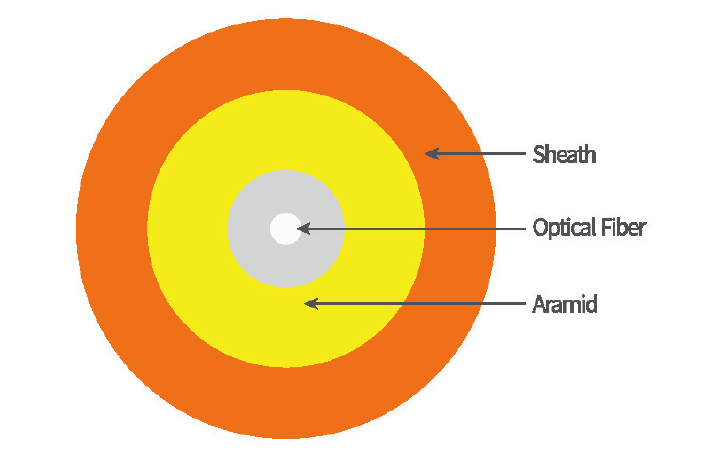
A fiber optic vibration sensing cable is the optical sensing path in a compatible vibration-detection system. This 2.9 ± 0.1 mm cable combines optical fiber, aramid reinforcement and an outer sheath for perimeter security and suspended or S-shaped cable routing.
The source catalog names this product “Vibration-resistant Optical Cable” and describes its use in vibration fiber optic sensing systems. Here, mechanical resistance protects the cable while the sensing fiber remains responsive to vibration. Opticlumos supplies the cable; the interrogator, alarm controller and detection performance must be specified separately.
Request Specifications & QuoteProduct Features
Mechanically reinforced construction
Aramid reinforcement supports short-term/long-term tensile loads of 350/180 N. The outer sheath protects the optical fiber during deployment.
Flexible sensing-route installation
The catalog describes suspended cable applications and S-shaped installation. Fixing method, route geometry and sensor coupling require project-specific review.
Defined crush and bend limits
Short-term/long-term crush resistance is 500/100 N per 100 mm. Minimum static/dynamic bending radii are 10D/20D.
Outdoor temperature range
The reference operating range is -40 to +85°C. Confirm the complete installation environment, terminations and any exposure requirements.
Product Specifications
| Characteristic | Unit | Specification |
|---|---|---|
| Catalog reference model | — | GTFJU-1SF2016-B |
| Cable outside diameter | mm | 2.9 ± 0.1 |
| Reference weight | kg/km | 10.7 |
| Attenuation at 850 nm | dB/km | ≤3.0 |
| Attenuation at 1300 nm | dB/km | ≤1.0 |
| Short-term tensile strength | N | 350 |
| Long-term tensile strength | N | 180 |
| Short-term crush resistance | N / 100 mm | 500 |
| Long-term crush resistance | N / 100 mm | 100 |
| Minimum static bending radius | D | 10D |
| Minimum dynamic bending radius | D | 20D |
| Operating temperature | °C | -40 to +85 |
D is the actual cable outside diameter. At the nominal 2.9 mm diameter, 10D/20D correspond to 29/58 mm; allow for the actual diameter and installation requirements. No detection distance, frequency response, spatial resolution, IP rating or interrogator compatibility is specified by this table. Final specifications and acceptance criteria are subject to order confirmation.
Applications & Selection
- Perimeter and boundary vibration-detection installations
- Airport perimeter security projects
- Suspended or S-shaped sensing routes subject to engineering approval
Information to Include in Your RFQ
Start with the interrogator’s supported fiber specification and wavelength. Confirm the route length, mounting surface, fixing method, minimum bends, cable loading and environmental exposure. Define acceptance testing with the system integrator; sensing sensitivity and detection range depend on the entire system, not the cable alone.
Frequently Asked Questions
Why is a vibration-resistant cable used for vibration sensing?
The catalog describes a mechanically robust cable intended for vibration sensing. Resistance to handling loads does not mean the sensing fiber is isolated from every vibration. Cable installation and coupling must be validated with the chosen detection system.
Can this cable be used with any DAS interrogator?
Compatibility is not established by the catalog. The reference attenuation is specified at 850 and 1300 nm. Confirm fiber type, wavelength, optical budget and sensing method with the interrogator supplier before ordering.
Is the interrogator or alarm system included?
This page describes the cable only. Interrogators, controllers, alarm software, detection thresholds and commissioning scope require separate confirmation.
What information is needed for quotation?
Provide the interrogator or required fiber specification, wavelength, total route length, mounting method, environment, mechanical loads, termination requirements and quantity.
Related Products & Technical Guides
Specify Your Vibration Sensing Cable
Send the sensing-system requirements, route layout, mounting conditions and quantity for a project-specific cable review.
Request Technical Review