
Optical Components & Connectors · PM Fiber Assemblies
Panda PM Fiber Jumper & Polarization-Maintaining Patch Cord
A high-precision Panda PM fiber jumper and polarization-maintaining fiber patch cord for coherent communication, interferometric sensing and precision photonics, available with FC/PC, FC/APC, LC/PC and LC/APC connector options.
Product Description
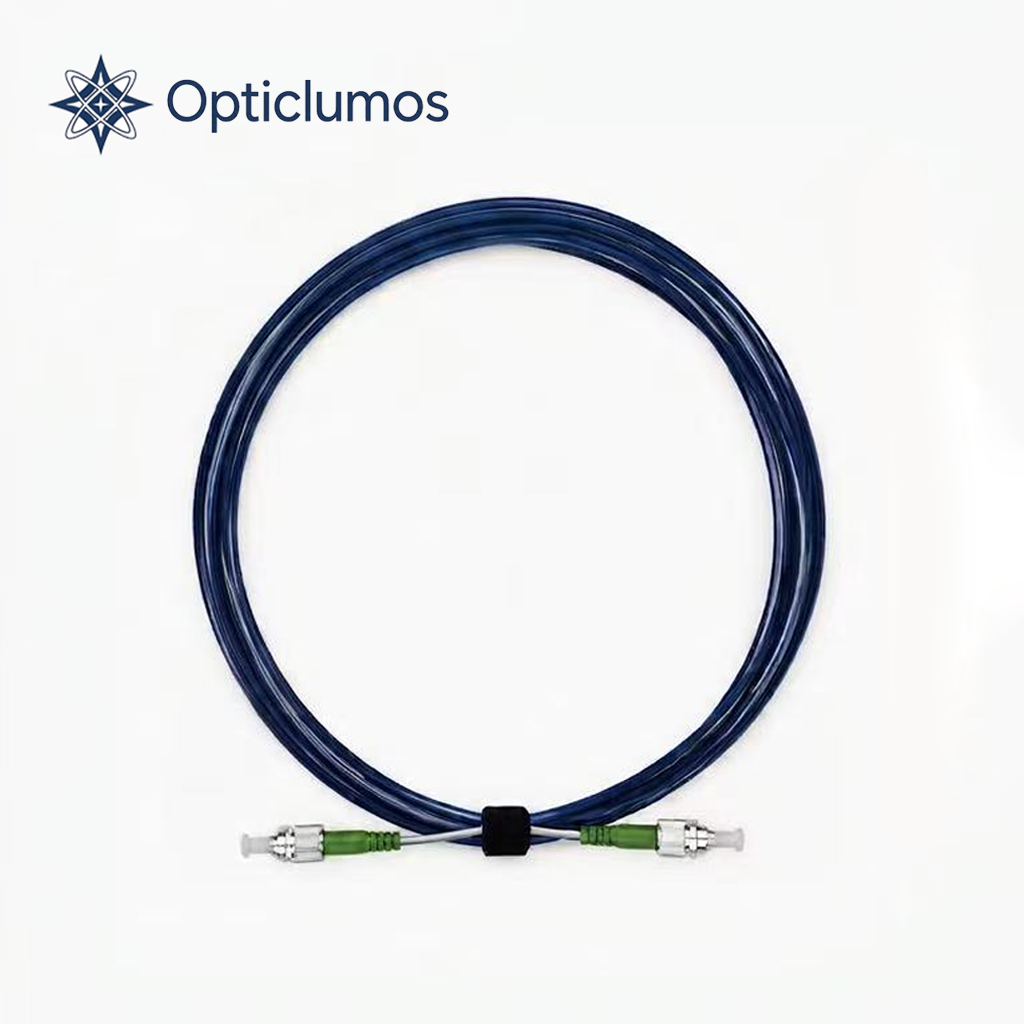
A Panda-type polarization-maintaining (PM) fiber jumper — also called a PM fiber patch cord or PM fiber patch cable — is built from PANDA polarization-maintaining fiber to preserve linearly polarized light launched along one of the fiber’s principal axes. We manufacture this PM fiber jumper with precision axial alignment and high-quality FC/PC or FC/APC connectors, with finished-assembly extinction ratio, insertion loss and mating-repeatability criteria confirmed for the selected configuration.
The polarization-maintaining fiber jumper uses panda-type polarization-maintaining fiber and undergoes a special process of alignment and adhesive curing to ensure minimal radial and torsional stress on the polarization-maintaining fiber during the jumper's manufacturing process, resulting in excellent polarization-maintaining characteristics. It is equipped with high-precision FC/PC or FC/APC connectors, offering excellent insertion and extraction repeatability.
Product Features
- High extinction ratio of 22~35dB;
- Insertion loss ≤0.3dB;
- Axial deviation ≤3°;
- Excellent compatibility with standard connectors;
- FC/APC high-return-loss connectors available;
- Axial angles can be customized based on customer requirements: fast axis, slow axis, adjustable, and other options for various types of polarization-maintaining fiber jumpers at 980nm, 1310nm, 1550nm, etc.
Product Application
- Coherent Communication
- Interferometric Sensing
- High-Speed Optical Fiber Communication
Panda Fiber Alignment Key Reference
Product Specification
| Characteristics | Unit | Product Specifications | ||
|---|---|---|---|---|
| 980nm | 1310nm | 1550nm | ||
| Connector Type | / | FC/PC, FC/APC, LC/PC, LC/APC | ||
| Mode Field Diameter | μm | 6.5±1 | 6.0±1 | 6.5±1, 10.15 |
| Cladding Diameter | μm | 125 | 80, 125 | 80, 125 |
| Operating Wavelength | nm | 980 | 1310 | 1550 |
| Operating Temperature | °C | -40~+85 | ||
| Sheath Size | mm | 0.9, 2.0, 3.0 Loose Tube, 0.9 Tight Buffer, Others | ||
| Code | Meaning | End Face Schematic | Description |
|---|---|---|---|
| F (Free) | Free Adjustable | The positioning key on the FC connector is non-fixed assembly, therefore, it can freely rotate when matched with equipment. This is especially suitable for laboratory or scientific research applications, where it allows for flexible adjustments of the connector's orientation and angle as needed, meeting the requirements of experiments or research projects. This flexibility ensures the accuracy and stability of fiber optic connections for precise optical measurements or experiments. | |
| X (Fast) | Fast Axis Alignment | The line formed by the centers of the two stress regions and the fiber core is perpendicular to the centerline of the positioning key. | |
| Y (Slow) | Slow Axis Alignment | The line formed by the centers of the two stress regions and the fiber core is parallel to the centerline of the positioning key. The polarization direction of most polarized light source equipment also aligns with this direction. | |
| O (Other) | Customer-specified angle | The angle between the line formed by the centers of the stress region and the fiber core and the centerline of the positioning key is specified by the customer. |
How to Specify a PM Fiber Jumper
For an accurate quotation, match the jumper to the source wavelength, polarization axis and connector interface. The finished assembly must be specified as a system; choosing only the PANDA fiber type is not enough to define connector key orientation, polishing or cable protection.
Select 980 nm, 1310 nm or 1550 nm and confirm the matching mode-field and cladding requirements.
Specify slow-axis (Y), fast-axis (X), free/adjustable (F) or a customer-defined angle (O).
Choose FC/PC, FC/APC, LC/PC or LC/APC and state the connector required at each end.
Provide jumper length, sheath size, operating environment, quantity and target insertion-loss or extinction-ratio requirement.
Confirm the acceptance test: state the measurement wavelength, launch-axis alignment, connector reference, cable length and bend conditions when specifying polarization extinction ratio (PER) and insertion loss. Confirm the agreed values for the finished assembly before ordering.
For a step-by-step checklist, read how to select a PM fiber jumper: PER, axis alignment and connectors.
Product relationship: this page covers the finished connectorized assembly. For the underlying optical fiber, review Panda polarization-maintaining fiber. For couplers, splitters and other compatible assemblies, browse optical components and connectors.
Frequently Asked Questions
What is a Panda-type polarization-maintaining (PM) fiber jumper?
A PANDA PM fiber jumper is a connectorized polarization-maintaining fiber assembly. Two stress-applying rods create birefringence that helps preserve linearly polarized light when it is launched along a principal axis. It does not turn arbitrary input light into a single linear polarization. Connector key alignment, wavelength, bends and termination quality affect the measured performance.
What is the difference between fast axis and slow axis alignment on a PM patch cord?
Fast axis and slow axis refer to the two orthogonal polarization axes inside a PANDA PM fiber, which propagate light at different speeds due to the fiber's built-in birefringence. The connector key can be aligned to either axis: slow axis alignment (code Y) places the line through the two stress regions parallel to the connector key, while fast axis alignment (code X) places that line perpendicular to the key. A free/adjustable option (code F) leaves the ferrule unlocked for rotation, and a customer-specified angle (code O) sets any angle required.
What extinction ratio and insertion loss does this PM fiber jumper achieve?
The catalog lists an extinction-ratio range of 22–35 dB, insertion loss ≤0.3 dB and axial deviation ≤3°. These are reference specifications, not a guarantee that every wavelength, connector and length combination achieves 35 dB. Agree the minimum finished-assembly PER and loss limits together with launch alignment, measurement wavelength, connector reference and bend conditions before ordering.
Which connectors are available for this polarization-maintaining fiber patch cord?
This PM fiber jumper is available with FC/PC, FC/APC, LC/PC and LC/APC connectors, all offering excellent insertion and extraction repeatability. FC/APC high-return-loss connectors can also be supplied for applications that are especially sensitive to back-reflection, such as narrow-linewidth lasers and coherent detection systems.
What operating wavelengths does this PM fiber jumper support?
This Panda PM fiber jumper is available for 980nm, 1310nm and 1550nm operating wavelengths, with mode field diameter and cladding diameter matched to each wavelength band. The wavelength version selected should match the laser source or system operating wavelength to maintain the specified extinction ratio.
Where are Panda PM fiber patch cords typically used?
Panda PM fiber patch cords are widely used in coherent optical communication, interferometric sensing, fiber optic gyroscopes and other high-speed optical fiber communication systems where the polarization state of light must stay stable and predictable. They are common in research laboratories, photonics instrumentation and telecom system integration projects.
Need a Custom Polarization-Maintaining Fiber Jumper?
Connector type, axis alignment, operating wavelength, sheath size and cable length can all be tailored to your setup — from fast-axis or slow-axis key alignment to a fully customer-specified angle.
Request a QuoteSpecifications on this page are provided by the manufacturer and subject to change without notice. Technical content reviewed: September 2026.