
Special Optical Fiber · High Nonlinearity Photonic Crystal Fiber (PCF)
High-Nonlinearity Photonics Crystal Fiber
A microstructured photonic crystal fiber with a hexagonal air-hole cladding and a nonlinear coefficient of 12.0 W⁻¹·km⁻¹ — engineered for supercontinuum generation, nonlinear signal processing, and broadband light source development.
Product Description
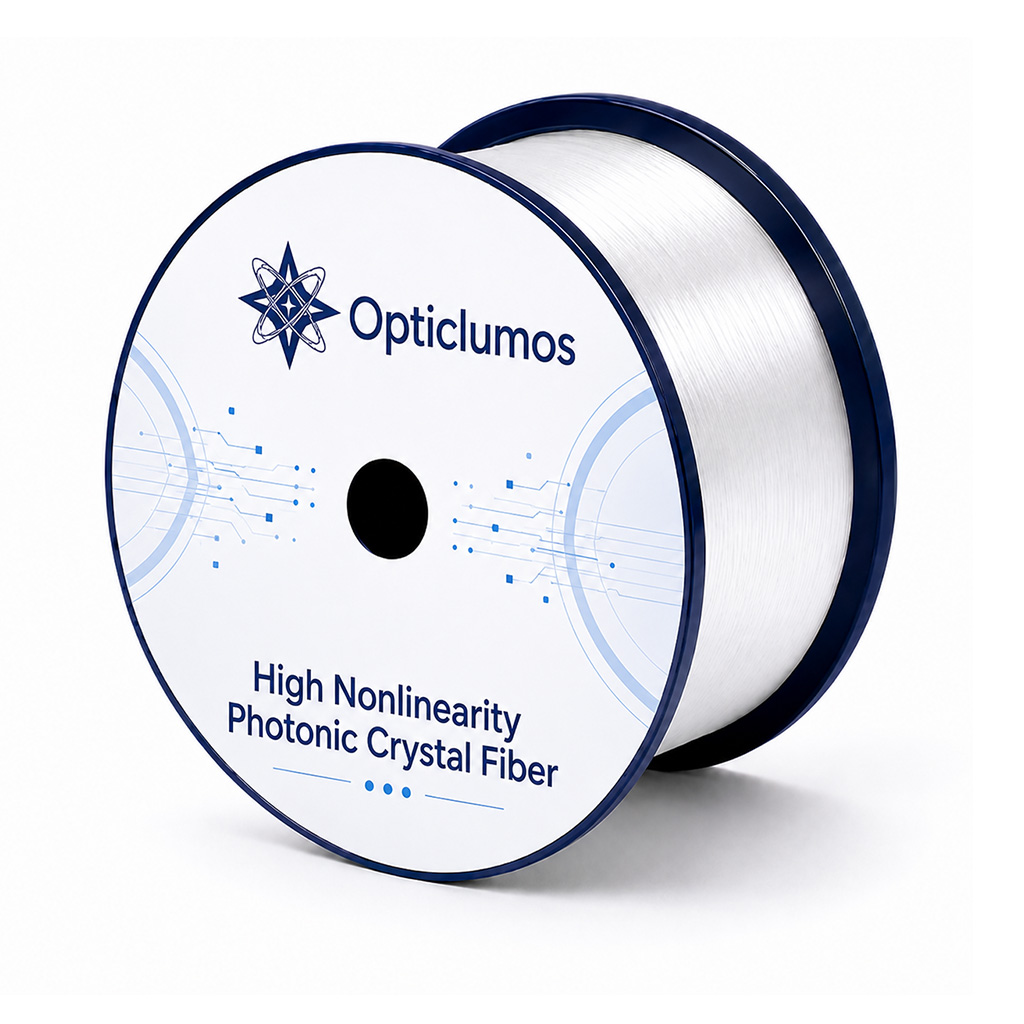
High-Nonlinearity Photonics Crystal Fiber — also called a highly nonlinear photonic crystal fiber (PCF) or HNL-PCF — is a specialty microstructured fiber built around a solid silica core surrounded by a precisely arranged hexagonal lattice of air holes. This air-hole microstructure creates a large refractive-index contrast that tightly confines light into a small mode field diameter, giving the fiber a nonlinear coefficient far higher than conventional single-mode fiber and making it an efficient platform for supercontinuum generation and other nonlinear optical processes.
Every fiber we supply is individually tested and shipped with a factory Optical Fiber Inspection Report covering mode field diameter, attenuation, and nonlinear coefficient. The reference values below are taken from a representative factory report (Fiber ID: C1P0001101B2E1P, tested length: 80m) and illustrate the level of measurement and traceability applied to every batch.
Fiber Properties
| Product name | High-Nonlinearity Photonics Crystal Fiber |
|---|---|
| Fiber ID (sample report) | C1P0001101B2E1P |
| Fiber length (m) | 80 |
| Test item | Value |
|---|---|
| Mode field diameter @1310nm (μm) | 4 |
| Mode field diameter @1550nm (μm) | 4.2 |
| Attenuation @1310nm (dB/km) | 3.25 |
| Attenuation @1550nm (dB/km) | 2.67 |
| Nonlinear Data (W⁻¹·km⁻¹) | 12.0 |
Photonic Crystal Fiber Cross-Section
- Solid core (center) — the missing air hole at the lattice center forms the light-guiding core.
- Air-hole cladding — a hexagonal array of air channels runs the full length of the fiber, creating a large index contrast against the solid core.
- Tight mode confinement — the high index contrast concentrates light into a small effective area, producing a high nonlinear coefficient.
Product Application
- Supercontinuum Generation
- Nonlinear Signal Processing
- Wavelength Conversion
- Optical Sensing & Metrology
Appearance & Factory Inspection
| Appearance Inspection Item | Result |
|---|---|
| There is no abnormal phenomenon of fiber coating and no impurity on the fiber surface. | Up to standard |
| The fiber is well aligned. Both ends of the fiber are fixed well. | Up to standard |
| The labels on optical fiber plate and cover must be in the correct format and in the legible fonts, and label position is pasted correctly and flatly. | Up to standard |
Storage Condition
- Storage humidity: 40~70%RH; Storage temperature: 25°C±5°C; store in the dark environment and keep away from the sparks and the fire.
- Long-term storage needs to retain the film and protective cover, and fiber optic plate is placed vertically (the axial direction of the optical fiber plate should be parallel to the ground).
Notes
- Avoid excessive bending, as a small bending radius can alter the refractive properties of the optical fiber and even damage it. Therefore, appropriate optical fiber bending protection devices can be used to prevent unnecessary bending of the fiber.
- Optical fibers are fragile, please do not place any items on top of them.
- Optical fibers are sensitive to moisture and should be used in dry environments. After use, the ports should be properly sealed to ensure the fiber performance is maintained.
Frequently Asked Questions
What is a high-nonlinearity photonic crystal fiber (PCF)?
A high-nonlinearity photonic crystal fiber is a microstructured optical fiber built from a solid silica core surrounded by a hexagonal lattice of air holes running along its length. The large refractive-index contrast between the solid core and the air-filled cladding tightly confines light into a very small effective area, which raises the fiber's nonlinear coefficient far above that of standard single-mode fiber. This makes the fiber highly efficient at generating nonlinear optical effects such as four-wave mixing, self-phase modulation, and supercontinuum generation.
What does the nonlinear coefficient of a highly nonlinear fiber mean?
The nonlinear coefficient, expressed in W⁻¹·km⁻¹, quantifies how strongly a fiber converts input optical power into nonlinear effects such as self-phase modulation and four-wave mixing over a given length. This High-Nonlinearity Photonics Crystal Fiber measures 12.0 W⁻¹·km⁻¹, well above standard single-mode fiber, allowing nonlinear effects like supercontinuum generation to be achieved with shorter fiber lengths and lower input power.
What is the mode field diameter of this photonic crystal fiber?
This fiber has a measured mode field diameter of 4µm at 1310nm and 4.2µm at 1550nm. A small mode field diameter concentrates optical power into a smaller effective area, which is one of the main reasons this photonic crystal fiber achieves such a high nonlinear coefficient.
What attenuation can I expect from this high-nonlinearity PCF?
Factory-tested attenuation for this fiber is 3.25dB/km at 1310nm and 2.67dB/km at 1550nm. These values are measured and recorded on an individual factory inspection report for every fiber before it ships.
What is high-nonlinearity photonic crystal fiber used for?
High-nonlinearity photonic crystal fiber is widely used for supercontinuum generation, nonlinear signal processing such as four-wave mixing and wavelength conversion, optical parametric amplification, and broadband light source development for spectroscopy, sensing, and metrology applications.
How should a photonic crystal fiber be stored and handled?
Store the fiber at 25°C±5°C and 40~70% relative humidity, away from sparks and open flame, in a dark environment. For long-term storage keep the protective film and cover in place and store the fiber optic plate vertically with its axial direction parallel to the ground. Avoid excessive bending, as a small bending radius can alter the fiber's refractive properties or damage it, and keep ports sealed after use since the fiber is sensitive to moisture.
Need a Custom Highly Nonlinear PCF?
Fiber length, nonlinear coefficient target, and dispersion profile can be discussed for your specific supercontinuum or nonlinear optics setup — every batch ships with a full factory inspection report.
Request a QuoteSpecifications on this page are based on factory inspection data and subject to change without notice. Page last updated: July 2026.