
- Home >
- Products >
- Special optical fiber >
- Photonic Crystal Fiber (PCF)
Photonic Crystal Fiber (PCF)
Based on synthetic raw materials and highly precise CVD technology, combined with meticulous theoretical simulation, we have developed a comprehensive suite of Photonic Crystal Fiber (PCF) products. Our advanced portfolio includes open-ended single-mode photonic crystal fiber, polarization-maintaining photonic crystal fiber, photosensitive photonic crystal fiber, highly nonlinear photonic crystal fiber, Bragg clad fiber, and hollow photonic crystal fiber products.
Product Features
- ✔Good radiation resistance ✔ Flexible structural design
- ✔The dispersion of optical fiber can be adjusted
- ✔The nonlinear coefficient of optical fiber can be adjusted
Application Field
- ✔Broadband single-mode transmission
- ✔Energy transmission
- ✔Gas and liquid sensing
- ✔Optical fiber communication
- ✔Fiber laser
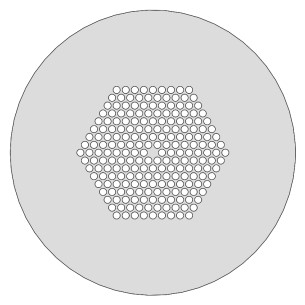
Optical Fiber Structure
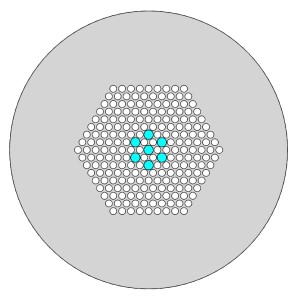
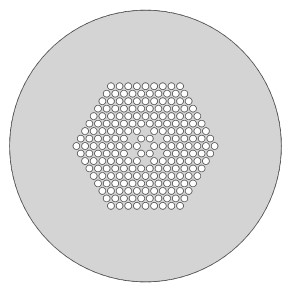
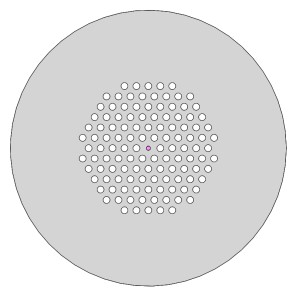
Product Specification
| Properties | Unit | Fluorine-Doped Core PCF (FDPCF-15-125-250) |
Multicore PCF (MCPCF-15-125-250) |
Photosensitive PCF (PSPCF-15-125-250) |
Highly Nonlinear PCF (HNPCF-15-125-250) |
|---|---|---|---|---|---|
| Optical Properties | |||||
| Working wavelength | nm | 1550 | 1550 | 1550 | 1550 |
| Attenuation | dB/km | ≤ 10 | ≤ 10 | ≤ 0.6 | ≤ 5 |
| Geometric Properties | |||||
| Core diameter | µm | 5.5 | 4.5 | 0.6 | 3.5 |
| Cladding diameter | µm | 125.0 ± 2.0 | 125.0 ± 2.0 | 125.0 ± 2.0 | 125.0 ± 2.0 |
| Cladding hole diameter | µm | 4.5 ± 0.2 | 3.5 ± 0.2 | 3 ± 0.2 | 3 ± 0.2 |
| Cladding hole spacing | µm | 5.5 ± 0.2 | 4.5 ± 0.2 | 5 ± 0.2 | 3.5 ± 0.2 |
| Feature information | Fluorine concentration ≤ 2.2wt% | Number of cores ≤ 7 | / | ||
Customized Information
- ✔The fiber core of high purity silicon, low hydroxyl, fluorine and germanium can be customized.
- ✔Capillaries of any size and duty cycle can be customized.
Advanced Applications & Technical Superiority
Leveraging precise CVD technology and cutting-edge optical engineering, our Photonic Crystal Fiber (PCF)—also known as microstructured optical fiber (MOF)—delivers unparalleled transmission integrity. By carefully engineering the microscopic arrangement of internal capillaries, we allow both the dispersion profile and the nonlinear coefficient to be precisely adjusted. This creates highly bespoke solutions for demanding environments where standard step-index fibers fall short.
Our advanced PCF lineup inherently provides excellent radiation-resistant optical fiber performance, ensuring stable operation across aerospace, industrial sensing, and high-energy physics applications. From broadband single-mode transmission to multi-core structural configurations and highly nonlinear PCF variations, these advanced optical materials are fundamentally reshaping next-generation gas and liquid sensing platforms, ultra-precise optical fiber communication, and cutting-edge fiber lasers.
Photonic Crystal Fiber (PCF) Buyer Guide
Photonic crystal fiber uses a microstructured cladding to tailor properties such as mode confinement, dispersion, nonlinearity, birefringence and light guidance. Selection depends on the application, operating wavelength, core and cladding structure, source characteristics and required optical performance.
PCF Types and Applications
- Single-mode and endlessly single-mode PCF for beam delivery and research systems
- Polarization-maintaining PCF for birefringence-sensitive applications
- Highly nonlinear PCF for supercontinuum generation and nonlinear optics
- Photosensitive PCF for grating-related research and sensing
- Hollow-core and Bragg-clad structures for application-specific light guidance
Information to Include in Your RFQ
- PCF type: solid-core, hollow-core, polarization-maintaining, photosensitive or highly nonlinear
- Operating wavelength, source type and optical power
- Pulse duration and repetition rate when applicable
- Mode-field, dispersion, nonlinearity or birefringence requirement
- Fiber length, coating, termination, test documentation and delivery destination
Frequently Asked Questions
How do solid-core and hollow-core PCF differ?
Solid-core PCF confines light in a solid core through its microstructured cladding, while hollow-core PCF guides a significant portion of the light in an air core. The best choice depends on wavelength, loss, dispersion, power handling and system architecture.
What system data is needed for a PCF recommendation?
Please provide source wavelength, spectral width, optical power, pulse duration and repetition rate when relevant, beam or mode requirements, dispersion or nonlinearity goals, required length and termination needs.
Can photonic crystal fiber be supplied with connectors?
Connectorization, splicing and termination feasibility depend on the PCF microstructure, coating, fiber dimensions and handling requirements. These details should be reviewed before quotation.
Technical inquiry: Sales@opticlumos.com · WhatsApp +86 13871596508