
Hybrid Fiber Optic & Power Cable
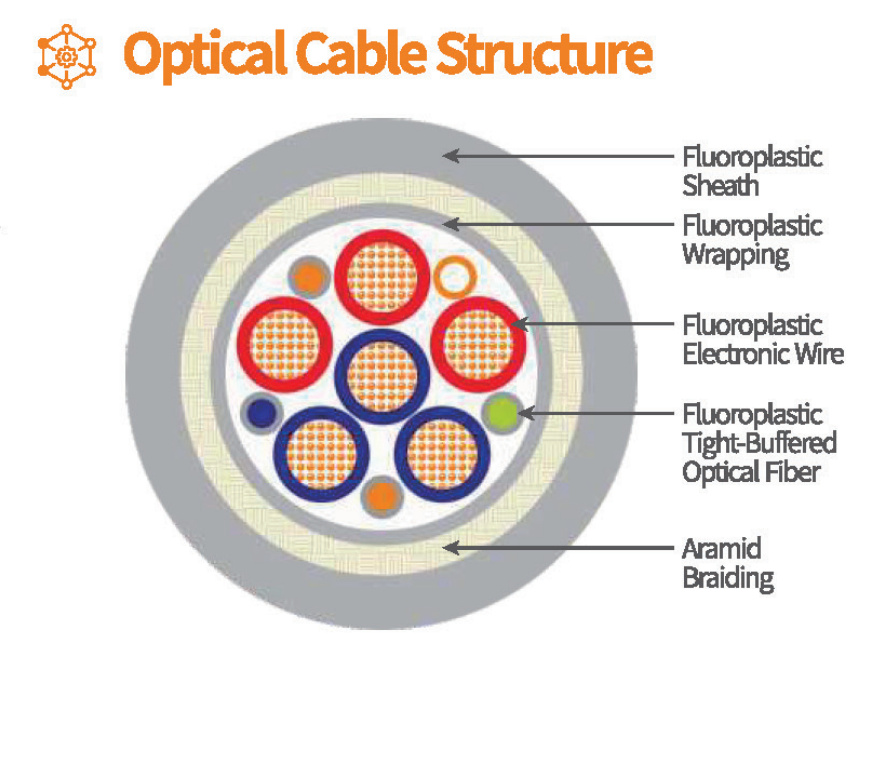
A hybrid fiber optic cable combines optical fibers and insulated electrical conductors in one compact construction so data transmission and electrical power or control can share a single cable route.
The reference Opticlumos configuration uses G652D optical fiber, fluoroplastic insulation and sheath materials, and aramid braiding for high-temperature, high-tensile B2B equipment and instrumentation projects.
Product Features
Reference Cable Construction
Reference Specifications
| Characteristic | Unit | Reference value |
|---|---|---|
| Optical cable unit diameter | mm | 0.35 ± 0.05 |
| Electrical unit diameter | mm | 0.92 ± 0.05 |
| Cable outer diameter | mm | 4.6 ± 0.3 |
| Weight | kg/km | 27.4 |
| Braiding / sheath | — | Aramid yarn / fluoroplastic |
| Long-term / short-term tensile force | N | 2,000 / 3,000 |
| Long-term / short-term crush force | N/10 cm | 200 / 400 |
| Long-term / short-term bending radius | D | 20 / 10 |
| Long-term operating temperature | °C | -55 to +200 |
| Short-term operating temperature | °C | -60 to +260 |
| Storage temperature | °C | -20 to +60 |
| Optical fiber / attenuation | dB/km | G652D; 0.4 @1310 nm, 0.3 @1550 nm |
| Operating / withstand voltage | VDC | 1,000 / 2,000 |
| Rated current | A | 14 |
| Insulation resistance | MΩ | 1,000 |
These values describe one reference configuration from the source document. Final electrical safety, fiber performance, conductor sizing and environmental qualification must be confirmed for the intended application.
Applications
Hybrid Cable Selection Guide
Key selection points
- Define optical fiber type, count, operating wavelength and loss budget.
- Confirm conductor count, gauge, voltage, current and insulation system.
- Review continuous, short-term and storage temperature requirements.
- Specify tensile load, crush load, bend radius and installation route.
- Confirm flame-retardant, salt-spray, humidity and qualification needs.
Information to include in your RFQ
- Fiber and conductor configuration
- Voltage, current and electrical test requirements
- Temperature, tensile, crush and bend requirements
- Overall length, termination and interface details
- Jacket, marking, flame-retardant and environmental requirements
- Quantity, delivery destination and required documentation
Frequently Asked Questions
What does a hybrid fiber optic cable carry?
It carries optical signals and electrical power or control circuits within one composite cable. The exact fiber and conductor configuration is selected for the equipment and installation requirements.
Can the optical and electrical units be customized?
Yes. Fiber type and count, conductor size and count, voltage/current rating, dimensions, materials, termination and environmental performance can be engineered for the project.
Which data is required to select the correct construction?
Provide optical loss and wavelength needs, voltage/current, conductor sizing, temperature, tensile and crush loads, bend radius, length, interfaces, standards and quantity.
Specify Your Hybrid Fiber & Power Cable
Send the optical, electrical, mechanical and environmental requirements for engineering review and a project-specific quotation.