
150mm Bending Insensitive G652D Single-Mode Fiber Preform
Opticlumos specializes in bending insensitive G652D single-mode fiber preforms. Engineered to meet ITUT G652D and ITUT G.657.A1 standards, our preforms deliver consistent performance for high-end optical network deployments.
1. Basic Geometrical Characteristics
| Effective Part Length (Leffective) | 1500 ~ 2400mm (95% ≥ 2200mm) |
| Total Length (Ltotal) | ≤ 3300mm |
| Average Outer Diameter | 145 ~ 155mm |
| Outer Diameter Fluctuations (Within Preform) | ≤ 10mm |
| Non-Circularity Error | ≤ 0.6% |
2. Unusual Appearance & Quality Standards
Our strict quality control defines the "unusual part" based on the following criteria:
| Items | Specifications |
|---|---|
| Bubbles in Core Portion | > 0.5mm marked as unusual; clustered bubbles (<15mm gap) merged for length calculation |
| Bubbles in Cladding Portion | > 2.4mm marked as unusual; clustered bubbles merged |
| Impurities | Not allowed; treated as unusual portion in length |
| Surface Scratches | > 0.5mm depth or > 10mm length marked as unusual |
3. Expected Fiber Characteristics (Table 3)
| Parameter | Value | Measurement Standard |
|---|---|---|
| Attenuation @1310nm / @1550nm | ≤0.34 / ≤0.20 dB/km | TIA FOTP 78 / IEC 60793-1-40 |
| Cable Cut-off Wavelength | ≤ 1260 nm | TIA FOTP 80 / IEC 60793-1-44 |
| Mode Field Diameter @1310nm | 8.8 ~ 9.6 µm | TIA FOTP 191 / IEC 60793-1-45 |
| Zero Dispersion Wavelength | 1300 ~ 1324 nm | TIA FOTP 175 / IEC 60793-1-42 |
| Cladding Non-Circularity | ≤ 0.8% | TIA FOTP 176 / IEC 60793-1-20 |
4. Usable Weight Calculation
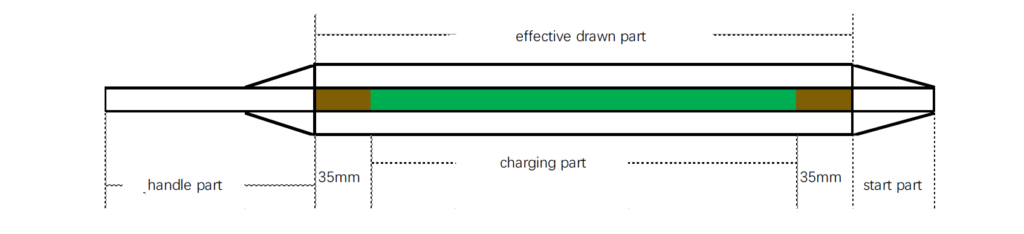
The chargeable weight is calculated based on a quartz glass density of 2.2g/cm³. Our precise calculation method ensures fair billing based on the actual usable preform length (Lcha), excluding defects.
Formula: W = (π/4) × OD_avg² × Lcha × (2.2/100) g
FAQ
What shapes of quartz glass incoming materials can Opticlumos process for custom preforms?
What is the maximum precision and depth achievable with your deep hole drilling technology?
Can you manufacture multi-faceted preforms for active doping and specialty fiber applications?
G.652.D Single-Mode Fiber Preform Buyer Guide
This 150 mm-class bending-insensitive single-mode preform is designed for drawing G.652.D fiber, with more than 60% of drawn fiber expected to meet G.657.A1 bending-performance requirements under suitable and stable drawing conditions. The specified average preform diameter is 145-155 mm.
Key Selection Points
- Confirm the target drawn-fiber standard: ITU-T G.652.D and any G.657.A1 bending-performance requirement.
- Review average outer diameter, within-preform diameter fluctuation, effective length and total length.
- Align draw-tower conditions with the target attenuation, mode-field diameter and cutoff wavelength.
- Define appearance-inspection, usable-length and charged-weight acceptance rules.
- Confirm testing, documentation, packaging and delivery requirements before production.
Expected Drawn-Fiber Performance
- Attenuation: ≤0.34 dB/km at 1310 nm and ≤0.20 dB/km at 1550 nm
- Cable cutoff wavelength: ≤1260 nm
- Mode-field diameter at 1310 nm: 8.8-9.6 µm
- Core-cladding concentricity error: ≤0.5 µm
- Values depend on appropriate, stable drawing and measurement conditions.
Information to Include in Your RFQ
- Target fiber standard and annual draw volume
- Required preform diameter, effective length and quantity
- Draw tower, furnace and coating-process information
- Required attenuation, MFD, cutoff and geometry targets
- Inspection report, packaging, delivery schedule and destination
Technical inquiry: Sales@opticlumos.com · WhatsApp +86 13871596508