
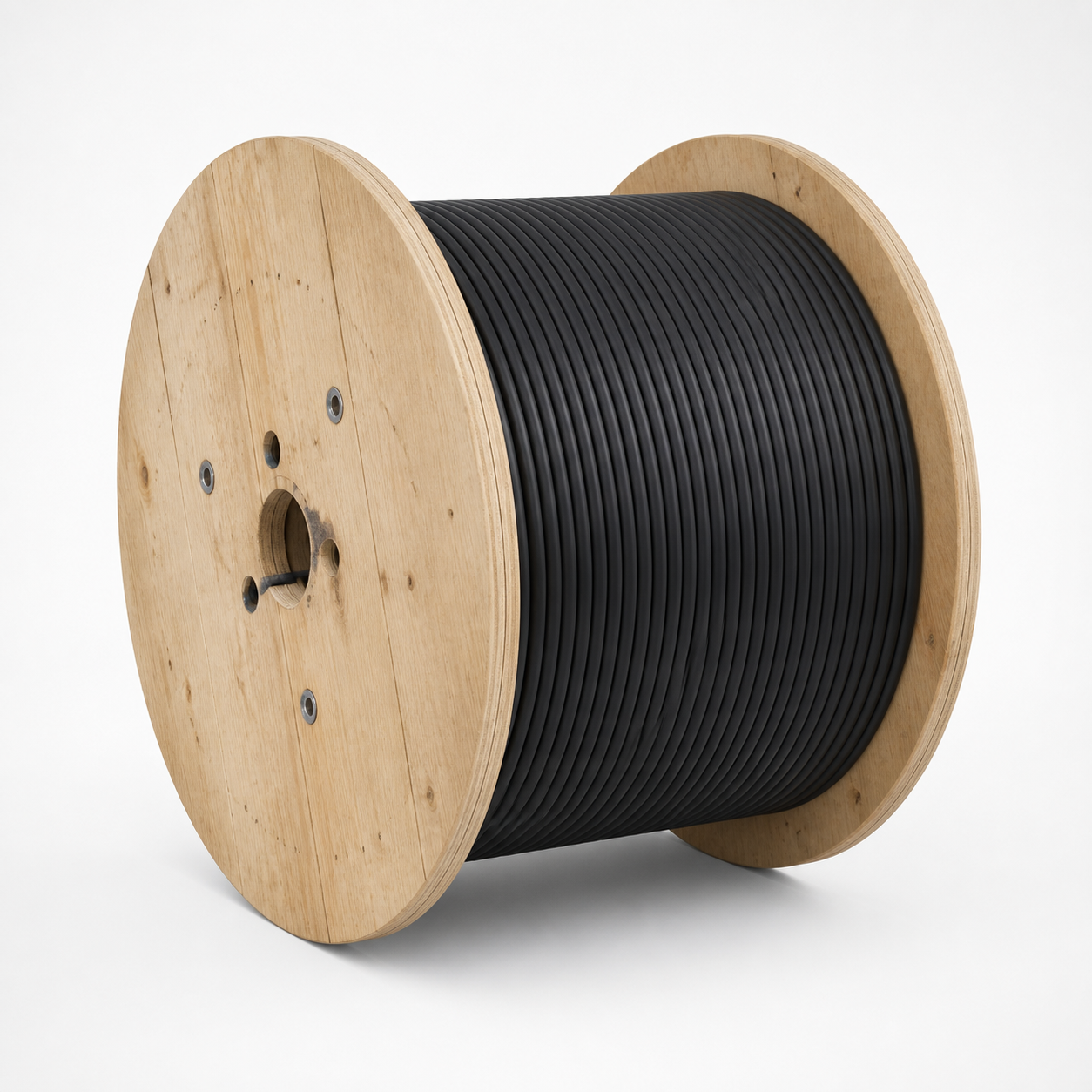
ADSS Fiber Optic Cable
All-dielectric self-supporting optical cable for 50–500 m aerial spans, available with 24–144 fibers, G.652D or G.655 fiber and project-specific single- or double-sheath construction.
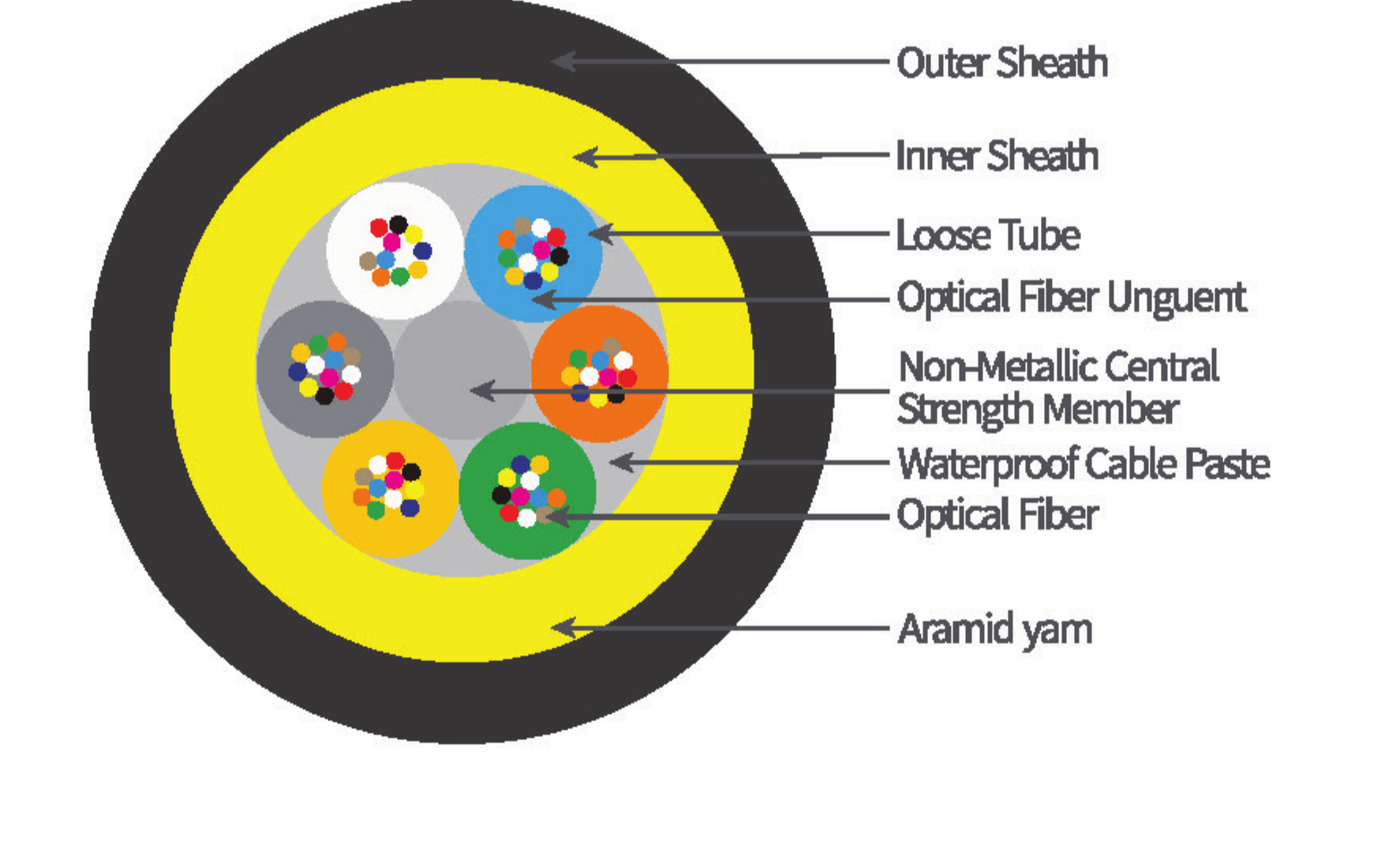
ADSS cable eliminates the metallic messenger wire and is engineered to support its own weight between poles or towers. Its non-metallic construction, aramid-yarn strength layer and PE or tracking-resistant sheath make it suitable for power-utility and telecom aerial networks.
Product Features
- All-dielectric, self-supporting aerial construction without a messenger wire
- Reference fiber counts from 24 to 144 fibers
- G.652D and G.655 optical fiber options
- Reference span designs from 50 to 500 meters
- Single- or double-sheath configurations for project review
- PE or tracking-resistant outer sheath options for utility environments
Cable Structure
Product Specification
| Reference model | Fiber count | Span length | Wind speed | Maximum allowable tension | Reference weight |
|---|---|---|---|---|---|
| ADSS-24F | 24 | 50 m | 25 m/s | 800 N | 65 kg/km |
| ADSS-48F | 48 | 100 m | 25 m/s | 1,700 N | 87 kg/km |
| ADSS-72F | 72 | 200 m | 25 m/s | 3,700 N | 128 kg/km |
| ADSS-96F | 96 | 300 m | 25 m/s | 4,500 N | 121 kg/km |
| ADSS-120F | 120 | 400 m | 25 m/s | 6,000 N | 137 kg/km |
| ADSS-144F | 144 | 500 m | 25 m/s | 8,700 N | 140 kg/km |
Reference values are based on a 25 m/s wind condition and 0 mm ice thickness. Final construction must be confirmed against span, sag, wind/ice load, electric-field environment and applicable installation standards.
Optical & Environmental Characteristics
| Parameter | G.652D | G.655 |
|---|---|---|
| Attenuation at 1310 nm | ≤0.36 dB/km | — |
| Attenuation at 1550 nm | ≤0.22 dB/km | ≤0.25 dB/km |
| Cable cutoff wavelength | ≤1260 nm | ≤1450 nm |
| Crush performance, long/short term | 1000 / 2200 N per 100 mm | |
| Minimum bend radius, static/dynamic | 12.5D / 20D | |
| Operating temperature | −40°C to +60°C | |
| Installation temperature | −10°C to +60°C | |
Applications
Power Utility Communications
Self-supporting fiber routes on transmission and distribution infrastructure.
Telecom Aerial Networks
Backbone, access and rural broadband deployment between poles or towers.
Industrial & Campus Links
Non-metallic aerial connections where electrical isolation is preferred.
Frequently Asked Questions
What does ADSS mean in fiber optic cable?
ADSS means All-Dielectric Self-Supporting. The cable contains no metallic messenger and supports its own weight between poles or towers within engineered loading limits.
How is the correct ADSS span selected?
Selection must consider span, fiber count, wind and ice load, sag, allowable tension, pole or tower geometry, installation temperature and electric-field exposure.
Can ADSS be installed near high-voltage conductors?
Yes, but the attachment position and outer-sheath material must be selected for the electric-field environment. Provide line voltage and installation geometry for review.
What should be included in an RFQ?
Provide fiber type and count, span schedule, maximum span, wind and ice conditions, cable length, sheath requirement, applicable standard, documentation and delivery location.
Need a Project-Specific ADSS Cable?
Send your span schedule, fiber count, environmental loading and installation conditions for engineering review and a factory-direct quotation.